Backers of plans to resurrect the abandoned Dumbarton Rail Bridge look forward to the day when commuters no longer clog freeways with cars but get from one place to another by train. Their high hopes are nothing compared to those who hailed the opening of the span in 1910.
“The distance from Oakland to San Francisco by way of the bridge is 26 miles less than by way of San Jose,” Frona Colburn wrote in a long column in the July 4, 1910, Redwood City Democrat. She was more concerned about what the bridge, the first on San Francisco Bay, would do for freight trains than for passengers, who seemed to be treated as an afterthought in the article. Her attitude was not surprising when one takes into account that at the time most people worked near their homes. The important contribution of the new bridge was that it meant “a great savings of time and simplifies the handling of freight cars.” There would be no need for what were referred to as “trans-bay freight boats.”
Freight trains dominated future business on the Dumbarton Bridge, but from 1912 to at least 1918, there was passenger service. In addition, there were some trains made up of both freight and passenger cars. There are still some old Dumbarton passenger timetables around that show trains ran from Newark to Redwood City where passengers could transfer for San Francisco or San Jose.
The optimistic Colburn forecast that “electric trains” would offer service “every 10 minutes.” Didn’t happen. What Colburn didn’t, or couldn’t, see was the future importance of the automobile. Cars and trucks, in just 10 years, had a huge impact on railroads. In 1927, a two-lane vehicle bridge opened adjacent to the rail bridge. In 1982, a four-lane bridge took over. Two years later, the center section of the 1927 bridge was demolished in a controlled explosion.
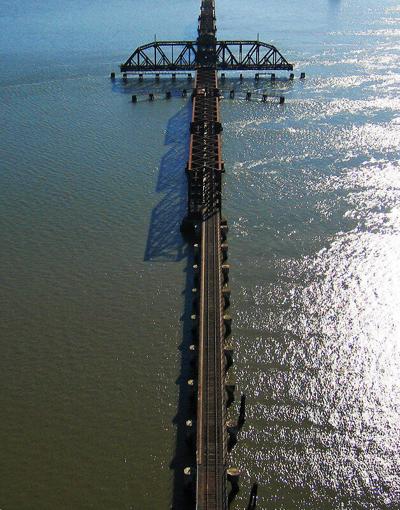
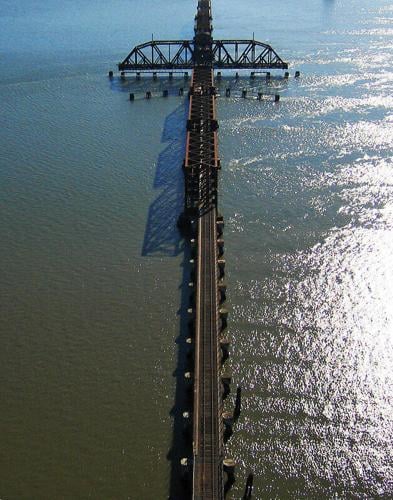
The rail bridge is only five miles long and has been out of service since the 1980s. On Jan. 2, 1998, a fire hit the abandoned structure that had seen the last freight train roll over its tracks in 1982. The blaze collapsed the western approach, but the span’s swinging section, which rotated to make way for boats, still stands, left in the open position. In the bridge’s heyday, boaters would signal the bridge operator who used a diesel engine to twist the section so vessels could pass.
Replacing or repairing and getting the rail bridge in working order is only one part of a massive plan called the Dumbarton Rail Corridor project, which totals 20.5 miles. The Bay Rail Alliance said that three new passenger rail stations should be built. Proposed service calls for six trains across the bridge during the morning commute and six during the evening. Morning trains would originate at Union City, cross the Bay and then three trains would travel north to San Francisco and three south to San Jose along Caltrain tracks. All trains would reverse pattern and go back to Union City.
“Other service patterns and frequency would be possible in the future as the service gains popularity,” the alliance said on its website. How’s that for optimism? Perhaps Frona Colburn wasn’t too far off track in 1910.
The Rear View Mirror by history columnist Jim Clifford appears in the Daily Journal every other Monday. Objects in The Mirror are closer than they appear.
Keep the discussion civilized. Absolutely NO
personal attacks or insults directed toward writers, nor others who
make comments. Keep it clean. Please avoid obscene, vulgar, lewd,
racist or sexually-oriented language. Don't threaten. Threats of harming another
person will not be tolerated. Be truthful. Don't knowingly lie about anyone
or anything. Be proactive. Use the 'Report' link on
each comment to let us know of abusive posts. PLEASE TURN OFF YOUR CAPS LOCK. Anyone violating these rules will be issued a
warning. After the warning, comment privileges can be
revoked.
Please purchase a Premium Subscription to continue reading.
To continue, please log in, or sign up for a new account.
We offer one free story view per month. If you register for an account, you will get two additional story views. After those three total views, we ask that you support us with a subscription.
A subscription to our digital content is so much more than just access to our valuable content. It means you’re helping to support a local community institution that has, from its very start, supported the betterment of our society. Thank you very much!








(0) comments
Welcome to the discussion.
Log In
Keep the discussion civilized. Absolutely NO personal attacks or insults directed toward writers, nor others who make comments.
Keep it clean. Please avoid obscene, vulgar, lewd, racist or sexually-oriented language.
Don't threaten. Threats of harming another person will not be tolerated.
Be truthful. Don't knowingly lie about anyone or anything.
Be proactive. Use the 'Report' link on each comment to let us know of abusive posts.
PLEASE TURN OFF YOUR CAPS LOCK.
Anyone violating these rules will be issued a warning. After the warning, comment privileges can be revoked.