
SAN FRANCISCO — David Halberstam, a Pulitzer Prize-winning journalist and author who chronicled the Vietnam War, the Washington press corps and the world of sports, was killed in a car crash Monday, according to his wife and local authorities. He was 73.
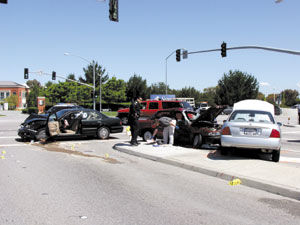
Halberstam, who lived in New York and Nantucket, Mass., was a passenger in a car that was broadsided by another vehicle in Menlo Park, south of San Francisco, according to San Mateo County Coroner Robert Foucrault. He said the cause of death appeared to be internal injuries.
The accident occurred around 10:30 a.m. and Halberstam was pronounced dead at the scene. The driver of the car carrying Halberstam and the operator of the car that crashed into his were both injured, but not seriously.
Halberstam was being driven by a graduate journalism student from the University of California, Berkeley, which hosted a speech by the author Saturday night about the craft of journalism and what it means to turn reporting into a work of history.
They were headed to an interview he had scheduled with Hall of Fame quarterback Y.A. Tittle. Halberstam was working on a new book, "The Game,” about the 1958 NFL championship game between the Baltimore Colts and the New York Giants, often called the greatest game ever played.
His wife, Jean Halberstam, said she would remember him most for his "unending, bottomless generosity to young journalists.”
"For someone who obviously was so competitive with himself, the generosity with other writers was incredible,” she said by telephone from their New York home.
As word of Halberstam’s death spread through the news industry, tributes and remembrances poured in for the veteran reporter whose deep baritone matched the heft of his nonfiction narratives on subjects as varied as the civil rights movement and basketball star Michael Jordan.
"The thing about David Halberstam was that he stayed the course and he kept the faith in the belief in the people’s right to know,” said George Esper, who spent 10 years in Vietnam with the AP and was Saigon bureau chief when that city fell in 1975. "The bottom line was that David was more honest with the American public than their own government.”
Halberstam recently had heart surgery to insert stents, recalled Richard Pyle, a former AP Vietnam bureau chief who first met Halberstam in Japan during the 1980s.
"He was an extremely generous man,” said Pyle, who added that his generosity extended to other writers. "He was interested in what other people were writing about.”
Author Gay Talese, who was at the Halberstams’ home Monday night, said he had known Halberstam since the early 1960s, was best man at his wedding and shared Thanksgiving dinner in Paris last year.
"He was a dear friend,” Talese said.
Born April 10, 1934, in New York City, to a surgeon father and teacher mother, Halberstam attended Harvard University, where he was managing editor of the Harvard Crimson newspaper.
After graduating in 1955, he launched his career at the Daily Times Leader, a small daily in West Point, Miss. He spent only a year at the newspaper because the editor at the time thought Halberstam was too politically liberal, said Bill Minor, Jackson bureau chief for the New Orleans Times-Picayune.
Minor met Halberstam in 1955 and they remained friends for decades. Unlike many professional journalists, Halberstam was not afraid to wear his social conscience on his sleeve, Minor said.
"He had a masterful touch as a historian and as a journalist. He was really an exceptional writer,” Minor said. "It’s a great loss to me personally, I can tell you that, as well as of course to American journalism.”
He went on to the Tennessean, in Nashville, where he covered the civil rights struggle, and then the New York Times, which sent him to Vietnam to cover the growing crisis there.
Recommended for you
In 1964, at age 30, he won the Pulitzer Prize for his reporting from Vietnam.
He later said he initially supported the U.S. action there, but became disillusioned. That disillusionment was apparent in Halberstam’s 1972 best-seller, "The Best and the Brightest” a critical accounting of U.S. involvement in the region.
Journalist Neil Sheehan, former Saigon bureau chief for United Press International, said he had lost his best friend, a man of enormous physical and mental energy who had "profound moral and physical courage.”
"We were in Vietnam at a time when we were being denounced by those on high,” said Sheehan, who went on to write "A Bright Shining Lie,” a Pulitzer Prize-winning account of the Vietnam War. "There was tremendous pressure. David never buckled under it at all. He was capable of standing up to it. You could not intimidate David.”
Sheehan recalled how Halberstam once called a general at home to get permission to fly to the site of a U.S. defeat. At a briefing the next day, a brigadier general scolded "pitiful, lowly young reporters” for having the temerity to call a general at home.
"General, you do not understand,” Halberstam responded, according to Sheehan. "We are not corporals. We do not work for you. ... We will call a commanding general any time at home we need to get our job done.”
The general was flabbergasted, Sheehan said.
"He had this wonderful sense of spirit,” Sheehan said. "I never thought I’d lose him. No one ever expected something like this.”
Halberstam quit daily journalism in 1967 and wrote 21 books. The most recent, "The Coldest Winter,” an account of a key early battle of the Korean War, is scheduled to be published in the fall.
His 2002 best-seller, "War in a Time of Peace,” was a runner-up for the Pulitzer Prize in nonfiction.
"He was a mentor, a companion and a very dear friend,” said Horst Faas, a retired AP photographer who met Halberstam in the Congo in 1960 and later shared a house with him in Saigon. "He was passionate about things. As a journalist he was very different from the rest of us. Not everybody went along with him, but he believed it was his duty to change things.”
In an interview earlier this month with the AP, Halberstam discussed how the industry has changed since Vietnam.
"We live in a time now when the values of that era seem never more distant,” he said. "Print is in decline for a variety of technological and economic reasons. ... (And) when it comes to big stories, more often than not, the networks do it in a preening way.”
He told journalists during a conference last year in Tennessee that government criticism of news reporters in Iraq reminded him of the way he was treated while covering the war in Vietnam.
"The crueler the war gets, the crueler the attacks get on anybody who doesn’t salute or play the game,” he said. "And then one day, the people who are doing the attacking look around and they’ve used up their credibility.”
———
Associated Press writers Kim Curtis and Brian Melley in San Francisco, Dino Hazell in New York and Chris Talbott in Jackson, Miss. contributed this report.










(0) comments
Welcome to the discussion.
Log In
Keep the discussion civilized. Absolutely NO personal attacks or insults directed toward writers, nor others who make comments.
Keep it clean. Please avoid obscene, vulgar, lewd, racist or sexually-oriented language.
Don't threaten. Threats of harming another person will not be tolerated.
Be truthful. Don't knowingly lie about anyone or anything.
Be proactive. Use the 'Report' link on each comment to let us know of abusive posts.
PLEASE TURN OFF YOUR CAPS LOCK.
Anyone violating these rules will be issued a warning. After the warning, comment privileges can be revoked.