
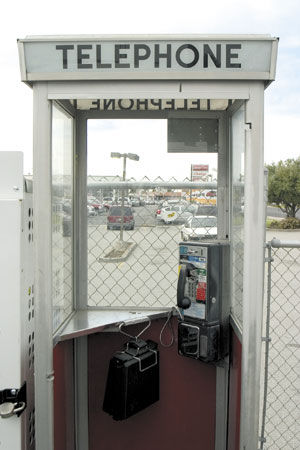
In the shadows of public buildings, hallways of dive bars and shopping centers sit thousands of relics reminiscent of another time.
They are pay phones. And they are being ripped from the cubbies that hold them or abandoned. In an era where cell phones dominate, there is a shrinking need for the coin-operated machines — especially in the mostly affluent San Mateo County.
The abandonment of pay phones by large companies has upset some operators who consider them a communication staple for low-income residents. At the same time, local pay phone operators are calling it quits and supplementing their income with other businesses.
"Our membership has dropped a lot in recent years,” said Darla Jorgenson, executive director for the California Payphone Association.
In fact, the phone number provided by Jorgenson for the only San Mateo County CPA member was disconnected.
The plummeting number of pay phones began approximately 10 years ago at approximately the same time cell phone companies began packaging minutes. Cell phone use is more than 150 million people, according to the 2004 U.S. Census.
The national total dropped from 2,086,540 in 1997 to 1,006,802 in 2006. Just more than 500,000 of those belong to independent providers, according to a National Payphones Clearinghouse document provided by Tom Keane, president of the National Payphone Association.
Only 2,031 of the 5,991 pay phones scattered through San Mateo County are still in use. The industry coins them as "claimed.” Local operators own even a smaller number of pay phones. National companies such as AT&T, Worldcom and Verizon operated most pay phones, according to records from the California Public Utilities Commission.
There are 3,962 unclaimed pay phones throughout the county, according to the report.
Recommended for you
Keane is the chief executive officer of the East Bay-based Jaroth Companies, which manages Pacific Telemanagement Services. The company manages all 38 pay phones at San Francisco International Airport, two in Pescadero and one in Millbrae, according to the PUC.
The "old-fashioned industry” is taking a serious hit, Keane said.
Pay phone operators make an agreement with landlords to either rent the location and keep the revenue or the landlord pays the rent and shares in the revenue. Since few people are without a cell phone, the use of pay phones had dropped dramatically, usually making landlord buy-in a hard sell. Other times, some business owners see it as a convenience to their patrons, Keane said.
The cost to operators to maintain the pay phones — coupled with their dwindling use — means operators are forced to supplement their income with other small business ventures. The same people who maintain pay phones will maintain Automated Teller Machines inside bars or air pressure and water machines at gas stations, Keane said.
Phone numbers for the only two local pay phone operators identified in the course of this report were disconnected.
No doubt, there is likely a pay phone operator trolling around San Mateo County fixing pay phones, ATMs and air machines, Keane said.
The future of pay phones is dim, but Keane isn’t writing it off yet. Where there is a need, there will be a pay phone. They may just be harder to find, he said.
Dana Yates can be reached by e-mail: dana@smdailyjournal.com or by phone: (650) 344-5200 ext. 106.


(0) comments
Welcome to the discussion.
Log In
Keep the discussion civilized. Absolutely NO personal attacks or insults directed toward writers, nor others who make comments.
Keep it clean. Please avoid obscene, vulgar, lewd, racist or sexually-oriented language.
Don't threaten. Threats of harming another person will not be tolerated.
Be truthful. Don't knowingly lie about anyone or anything.
Be proactive. Use the 'Report' link on each comment to let us know of abusive posts.
PLEASE TURN OFF YOUR CAPS LOCK.
Anyone violating these rules will be issued a warning. After the warning, comment privileges can be revoked.