
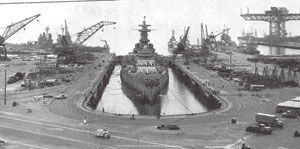
I have just been alerted by Angelo Demattei, a docent aboard the restored cargo ship, the Jeremiah O’Brien. The battleship, USS Iowa (BB-61) has been moved from Suisan Bay to Port Richmond. It is to be there for three months for volunteers to work on it and refurbish it. When the work is done, it will be towed to San Pedro (near Los Angeles/Long Beach) and become a floating museum.
The USS Iowa is the last of America’s battleships and the last chance for interested citizens to work on a battleship to get it ready to become a museum.
The history of American battleships begins with the Maine and Texas being built and authorized as "coast defense battleships.” They had four turrets, a 21-knot top speed, heavy armor and had 14-inch or 16-inch guns. The U.S. Navy commissioned 10 more battleships of entirely new style in the 1930s as the first ones were obsolete. Nine 16-inch guns (plus other smaller armament) were placed on the ships and their speed increased to keep up with the aircraft carriers that were becoming more popular.
The USS Iowa was ordered built July 1, 1939 and laid down on June 27, 1940. It was commissioned Feb. 22, 1943. It immediately entered the Atlantic and went to Argentina, Newfoundland to counter the German battleship, Tirpitz. After returning to the Norfolk Navy Yard for maintenance, it carried President Franklin Delano Roosevelt, Secretary of State Cordell Hull and numerous World War II military brass to Casablanca, French Morocco then over to the Tehran Conference.
The Iowa departed for the Pacific Ocean on Jan. 2, 1944. In the Pacific war zone, the Iowa completed numerous assignments against the Japanese at Kwajalein and Eniwetok atolls, supported air strikes at Truk, Caroline Islands and supported air strikes against Saipan, Rota and Guam in the Mariana Islands. After numerous other engagements, the Iowa headed back to the United States in December 1944. It found itself in another type of fight — a typhoon (Cobra) hit the fleet. Although no sailors aboard the Iowa were injured, approximately 790 officers and men were killed when destroyers capsized, air planes aboard the three aircraft carriers broke loose and exploded (146 were swept overboard or caught fire). The Iowa returned to San Francisco to repair a damaged shaft. At this point, new search radars and fire-control systems were outfitted to the battleship.
Returning to Japan, the Iowa was used as the Third Fleet Flagship at the signing of the Japanese surrender in Tokyo Bay.
Recommended for you
In 1949, the battleship was deactivated and returned to San Francisco to be "mothballed.” However, on July 14, 1951, she was reactivated due to the Korean War. Her assignments included war raids on the North Korean coast. In February 1958, the Iowa was again decommissioned and placed on the U.S. Navy reserve fleet. Again in 1982, the Iowa was reactivated because of the escalation of the Cold War between the United States and the Soviet Union. President Reagan authorized 600 ships to be ready to counter the Soviet threat. In 1990, the Iowa was decommissioned for the last time (maybe). In 1999, she was again added to the Naval Vessel Register (she had been struck from it in 1995) for technical reasons. This lasted only until 2011 when the USS Iowa was donated to the port of Los Angeles to be used as a museum in conjunction with the Pacific Battleship Center at San Pedro, Calif.
This is why Angelo Demattei sent me an email in hopes of recruiting men to restore the USS Iowa battleship to museum status. It will be hard, dirty, physical labor on board the ship with long hours and no pay. You will even have to bring your own tools and lunch to work on the ship. There is no water or electricity available on the ship. The entire decking that consists of wood plank and studs have to be removed as it has rotted. Everything needs to be cleaned and painted (in dark areas as well) and all of the seals (thousands of them) need to be inspected. Sounds like fun. Angelo and his buddies helped restore the Jeremiah O’Brien so they are familiar with what is required to complete the project.
If you are interested, email sschmidt@battleship.com. Sue is the volunteer coordinator. Talk to her, you may have some skills that are needed. This is the last of the battleships that can be saved and the personal reward of working on the USS Iowa will be something of which you can be proud.
Rediscovering the Peninsula by Darold Fredricks appears in the Monday edition of the Daily Journal.



(0) comments
Welcome to the discussion.
Log In
Keep the discussion civilized. Absolutely NO personal attacks or insults directed toward writers, nor others who make comments.
Keep it clean. Please avoid obscene, vulgar, lewd, racist or sexually-oriented language.
Don't threaten. Threats of harming another person will not be tolerated.
Be truthful. Don't knowingly lie about anyone or anything.
Be proactive. Use the 'Report' link on each comment to let us know of abusive posts.
PLEASE TURN OFF YOUR CAPS LOCK.
Anyone violating these rules will be issued a warning. After the warning, comment privileges can be revoked.