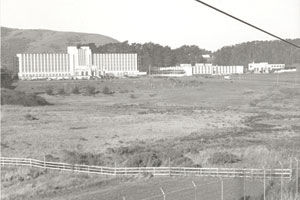
Originally known as "Jail House Road,” the one-and-a-half lane dirt road wound around the east and south slopes of Pacific Heights and ended at "Sunshine Jail Farm.” You reached this path (now Moreland Drive in western San Bruno) after driving south from San Francisco’s Ingleside Jail in the 1930s. The wooden Ingleside Jail in western San Francisco had become too small and overcrowded and besides that, the citizens of San Francisco didn’t want that type of dirty, noisy institution in its city limits. Land of Rancho Buri Buri of San Mateo County had been purchased by Richard Sneath in the 1870s but the dairy had closed down by the 1930s and the Sneath family was renting out land to vegetable growers and was also willing to sell some land to the San Francisco’s Sheriff’s Office to be used as a jail. Many acres of land to the west of the two square miles of incorporated San Bruno seemed to be isolated enough so Peninsula citizens would not be bothered by the daily bus loads of prisoners that shuttled between San Francisco and the jail. Not so. Immediately there were protests to deny the jail permit to the San Francisco Board of Supervisors but those were beat down by San Francisco and, in 1932, the jail property was purchased for $47,500. The construction of the jail was to cost $800,000.
A six-story art deco structure was erected with 50-yard long corridors of jail cells that opened to house 300 prisoners. San Mateo County Sheriff McGrath immediately purchased a Thompson machine gun for $277 to combat banditry in the county. He felt that the jail would promote crime.
To provide supplemental food for the prisoners, a vegetable garden covering many acres was planted and maintained by the prisoners. The food was awful, recreation minimal and the jail became overcrowded, especially at the beginning of the week when all of the party goers (drunks) filled the cells awaiting trial or serving sentences. A number of "breakouts” occurred over the years but the prisoners who broke out tended to head over the hill to the west (not east where people lived) and then hitch-hiked to shelter in San Francisco. These occasional breakouts did not sit well with the citizens and protests were registered with the San Francisco sheriff to no avail. The buses kept rolling every day with new loads of "minimum security” prisoners to San Bruno and then returned with "dried-out” prisoners who usually were on the returning buses come next Monday.
Sheriff Michael Hennessey, a reform-minded public officer and decent fellow who hated to see the jail deteriorating into the state it had become, finally had enough. This was in the mid-1990s. The jail had to be replaced but the bond issue that was voted on in 1994 was defeated. Another bond failed in 1996. Finally, money became available and, in 2000, construction on a new 300,000-square-foot, 368-bed jail began. Opening date was to be November 2003, but the date came and went and the opening of the medium-security facility was delayed. Sixteen semi-circular housing units (pods) each painted different bright colors for identification, radiated out from a central security station where the jailers could view every prisoner that was in the double-occupancy cell (total 768 beds). This facility was to be run electronically with 374 closed-circuit television monitors and electronically controlled doors. No keys. A recreation center was developed inside the walls of the facility as well as dental and medical facilities. For those who wanted to pursue their education, the Five-Keys Charter High School is available to pursue a high school diploma.
Opening deadlines were changed many times but, finally in August 2006, 14 months behind schedule, the new state-of-the-art facility opened with 600 inmates secure in their cells.
The buses continue to roll to the jail in the mornings but the food has improved and less noise is now generated due to the design of the new jail house facility. The vegetable fields are still being planted for the next crop to be served at the jail.
In January 2012 demolition of the uninhabitable 1934 art deco jail began.
Rediscovering the Peninsula by Darold Fredricks appears in the Monday edition of the Daily Journal.
Keep the discussion civilized. Absolutely NO
personal attacks or insults directed toward writers, nor others who
make comments. Keep it clean. Please avoid obscene, vulgar, lewd,
racist or sexually-oriented language. Don't threaten. Threats of harming another
person will not be tolerated. Be truthful. Don't knowingly lie about anyone
or anything. Be proactive. Use the 'Report' link on
each comment to let us know of abusive posts. PLEASE TURN OFF YOUR CAPS LOCK. Anyone violating these rules will be issued a
warning. After the warning, comment privileges can be
revoked.
Please purchase a Premium Subscription to continue reading.
To continue, please log in, or sign up for a new account.
We offer one free story view per month. If you register for an account, you will get two additional story views. After those three total views, we ask that you support us with a subscription.
A subscription to our digital content is so much more than just access to our valuable content. It means you’re helping to support a local community institution that has, from its very start, supported the betterment of our society. Thank you very much!











(0) comments
Welcome to the discussion.
Log In
Keep the discussion civilized. Absolutely NO personal attacks or insults directed toward writers, nor others who make comments.
Keep it clean. Please avoid obscene, vulgar, lewd, racist or sexually-oriented language.
Don't threaten. Threats of harming another person will not be tolerated.
Be truthful. Don't knowingly lie about anyone or anything.
Be proactive. Use the 'Report' link on each comment to let us know of abusive posts.
PLEASE TURN OFF YOUR CAPS LOCK.
Anyone violating these rules will be issued a warning. After the warning, comment privileges can be revoked.