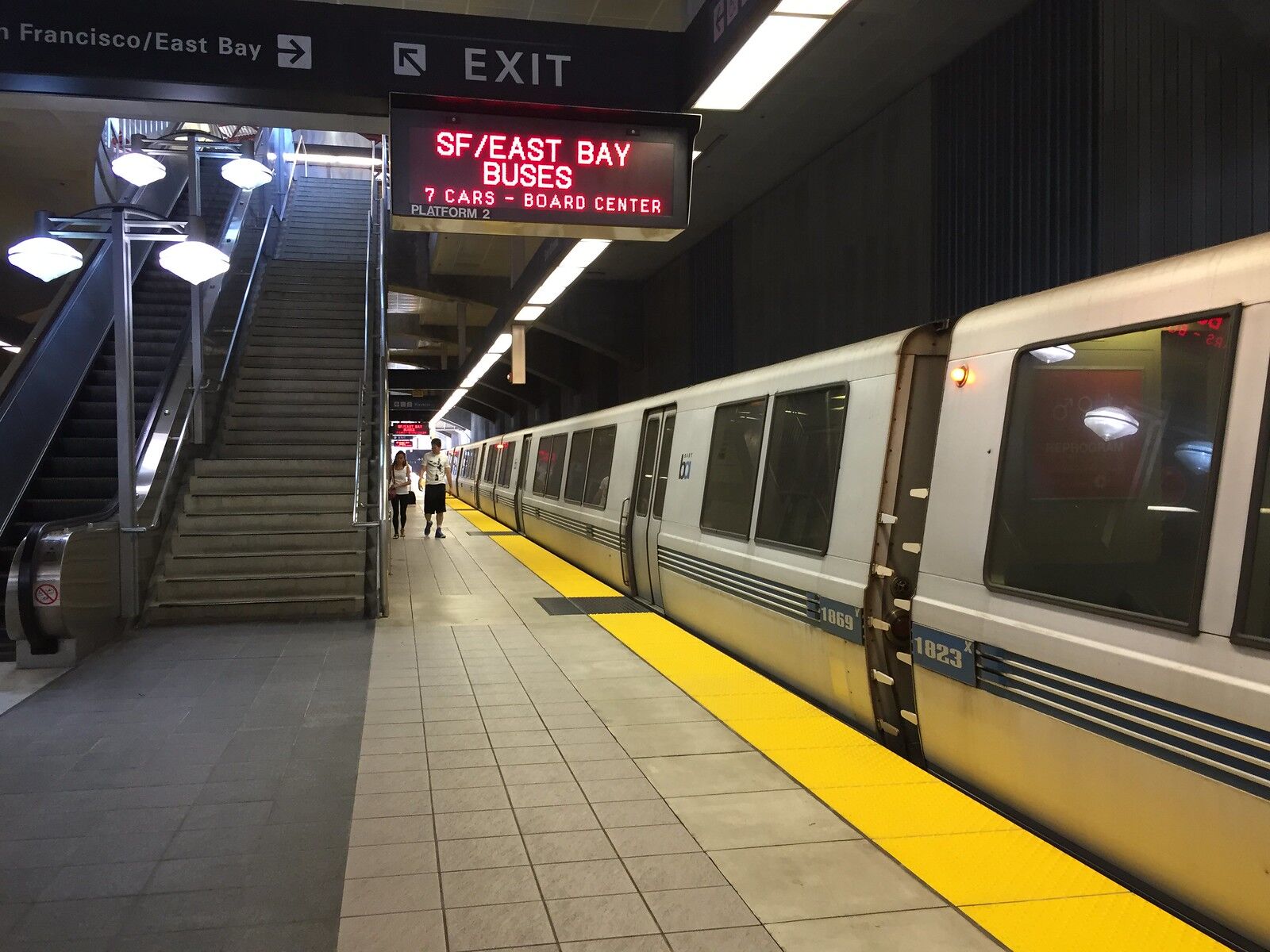
San Bruno’s recent decision not to enter into negotiations with the county for a loan program that would help fund construction of new Bay Area Rapid Transit station fare gates is raising questions about the plan’s future.
The decision was made based on potential funding gaps — BART is applying for a grant to fund the new gates through the San Mateo County Transportation Authority, but will not know if funds will be awarded until late summer, and had to give notice to its contractor for the cheapest possible price by March 31.
If BART does not receive the Measure W Regional Transit Connection Program grant, cities would ultimately repay the county for the installation of gates at their respective jurisdictions. The five cities involved in the new fare gate program — San Bruno, South San Francisco, Daly City, Millbrae and Colma — have been deciding over the past several weeks whether to enter into negotiations on a memorandum of understanding for what that loan repayment would look like.
Some cities, like Daly City and South San Francisco, have chosen to move forward with that negotiation. Other areas, like San Bruno and unincorporated Colma, will not be participating in the bridge loan program, their city councils decided. Millbrae has yet to discuss the proposition.
If San Bruno doesn’t reconsider their decision, the city will have to independently work out arrangements with BART, David Canepa, president of the San Mateo County Board of Supervisors, said. The bridge loan program — which would allow cities to repay the county interest-free over a 10-year period — is appealing because it leverages existing partnerships to make installation a seamless countywide process.
“If I was on the City Council, I’d take the county deal. [We’re] already doing the work. The existing relationship with BART makes it pretty seamless and there’s the uniformity,” he said. “Now what happens is BART may have to … negotiate one-offs, and that can be somewhat difficult. What we were doing was trying to make it easier.”
When asked about the specific future of fare gates for cities that don’t participate in the bridge loan program, BART Media Relations Manager Jim Allison said in an email that more time would be required to respond to specific questions.
Recommended for you
“BART is committed to installing next generation fare gates at all 50 stations by the end of the year and we have achieved 60 percent of that goal,” his email read. “We are focused on following through on our commitment and improving the customer experience.”
The fare gate effort in San Mateo County is part of a larger, $90 million effort to replace existing and aging fare gates throughout the BART system. In return for the county’s quasi-loan, BART said it would maintain the upgraded security gates, coordinate to increase fare enforcement and provide police presence at the five stations, improve maintenance at stations and support retail operations nearby.
San Bruno’s City Council voted 3-2 not to move forward with negotiations for a memorandum of the city over objections from Mayor Rico Medina at a City Council meeting April 22. The city should see what directions other jurisdictions were moving in and could go into negotiations without committing to repaying the loan, he said.
“I believe it’s worth us trying to stay in the game a little bit longer to see how it plays out,” he said.
Ultimately, councilmembers balked at committing themselves to the price tag associated with the project. The $1.6 million for fare gate installation at the San Bruno BART station alone should be taken on by BART, Vice Mayor Michael Salazar said.
He acknowledged that the benefits to fare gates, including enhancing safety, reducing crime and fare evasion and increasing revenues, were clear, but maintained that the financial burden should not be San Bruno or San Mateo County’s responsibility.
“I don’t disagree that BART needs these gates, and I think they’ve known that for a long time,” Salazar said. “I don’t understand where the mentality comes from that because their stations happen to be in our cities, that we have to put up money to support their operations.”
Keep the discussion civilized. Absolutely NO
personal attacks or insults directed toward writers, nor others who
make comments. Keep it clean. Please avoid obscene, vulgar, lewd,
racist or sexually-oriented language. Don't threaten. Threats of harming another
person will not be tolerated. Be truthful. Don't knowingly lie about anyone
or anything. Be proactive. Use the 'Report' link on
each comment to let us know of abusive posts. PLEASE TURN OFF YOUR CAPS LOCK. Anyone violating these rules will be issued a
warning. After the warning, comment privileges can be
revoked.
Please purchase a Premium Subscription to continue reading.
To continue, please log in, or sign up for a new account.
We offer one free story view per month. If you register for an account, you will get two additional story views. After those three total views, we ask that you support us with a subscription.
A subscription to our digital content is so much more than just access to our valuable content. It means you’re helping to support a local community institution that has, from its very start, supported the betterment of our society. Thank you very much!












(0) comments
Welcome to the discussion.
Log In
Keep the discussion civilized. Absolutely NO personal attacks or insults directed toward writers, nor others who make comments.
Keep it clean. Please avoid obscene, vulgar, lewd, racist or sexually-oriented language.
Don't threaten. Threats of harming another person will not be tolerated.
Be truthful. Don't knowingly lie about anyone or anything.
Be proactive. Use the 'Report' link on each comment to let us know of abusive posts.
PLEASE TURN OFF YOUR CAPS LOCK.
Anyone violating these rules will be issued a warning. After the warning, comment privileges can be revoked.