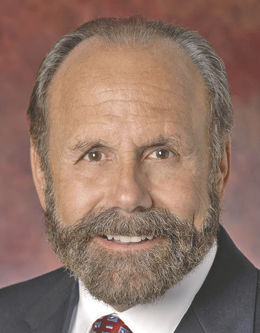
School districts will be able to stash more money for a rainy day in reserve funds through the governor’s signature to create a new law authored by state Sen. Jerry Hill, D-San Mateo.
Gov. Jerry Brown signed Hill’s Senate Bill 751 Wednesday, Oct. 11, allowing the cap to be lifted for school districts seeking to store funds for periods of economic uncertainty.
Under the signing, the cap on the amount of money districts are allowed to keep in reserves jumps to 10 percent of the general fund balance, up 4 percent from the previous amount allowed.
Hill, in a prepared statement, expressed his appreciation for Brown’s support on an initiative he has long pursued.
“Californians have not forgotten the hard lessons of the Great Recession. They approved a rainy-day fund for the entire state to prevent devastating cuts when downturns occur,” Hill said. “This legislation enables school districts to better protect themselves against economic downturns.”
Alisa MacAvoy, a member of the Redwood City Elementary School District Board of Trustees and Region 5 director for the California School Boards Association, praised Hill’s vision for the bill.
“I am grateful for the local leadership that Sen. Jerry Hill showed in carrying this piece of legislation. It will allow local school districts to better manage their budgets and provide education to students over the long term,” she said in an email.
The law, which takes effect Jan. 1, stands to have a significant impact locally as it exempts from reserve cap provisions school districts funded through community property taxes or those with average daily attendance of less than 2,501 students.
Under the basic aid exemptions, both the San Mateo and Sequoia union high school districts would not be subject to the reserve caps, plus some of the other well-funded elementary districts in San Mateo County.
MacAvoy had advocated in favor of previous iterations of a similar bill which failed, claiming it was necessary to allow them to better prepare for the threat of future uncertainty.
During the Great Recession, MacAvoy’s district leaned heavily on their reserve funds and she had claimed that a similar cap at the time would have greatly impaired officials’ ability to manage the difficult time.
The California School Boards Association also lauded Brown for signing the legislation.
Recommended for you
“This bill is a victory for school districts and all Californians who believe schools should be allowed to save for a rainy day,” CSBA President Susan Henry said in an prepared statement. “The reserve cap, as previously constructed, limited the ability of school boards to work with constituents to make prudent financial decisions.”
The cap was initially installed in 2014 as a budget trailer bill. Shortly following its implementation, many districts opposed it under the belief it is too restrictive and limited local control.
Hill’s most recent bill is an amended version of legislation he authored last year which aimed to boost the allowable cap to 17 percent of the general fund. The new legislation also assures revenue used for construction, cafeterias or other supports will not count toward the reserve limit. The bill also modifies the cap trigger, making it less likely the reserve limit would take effect.
Brown, in his signing message, touted the bill’s intent to offer district’s greater authority in managing financial assets.
“This bill makes reasonable and appropriate changes to existing law to provide schools with adequate flexibility necessary to maintain fiscal solvency while simultaneously providing the education students they are currently serving,” he said.
He noted though more work needs to be done clarifying the cap law to assure its appropriately implemented if the reserve cap is triggered, and directed members of the state Department of Finance to work with Hill assuring the legislation is appropriately amended.
Marc Friedman, San Mateo Union High School District Board of Trustees member and president of the county’s California School Boards Association chapter, acknowledged the intent of the bill.
“It takes the reserve cap off the plate for smaller districts and basic aid districts, and that’s appropriate,” he said.
But he suggested more effort is required by legislators to address greater needs such as improving the state school funding model to offer more money to districts suffering financially.
Keep the discussion civilized. Absolutely NO
personal attacks or insults directed toward writers, nor others who
make comments. Keep it clean. Please avoid obscene, vulgar, lewd,
racist or sexually-oriented language. Don't threaten. Threats of harming another
person will not be tolerated. Be truthful. Don't knowingly lie about anyone
or anything. Be proactive. Use the 'Report' link on
each comment to let us know of abusive posts. PLEASE TURN OFF YOUR CAPS LOCK. Anyone violating these rules will be issued a
warning. After the warning, comment privileges can be
revoked.
Please purchase a Premium Subscription to continue reading.
To continue, please log in, or sign up for a new account.
We offer one free story view per month. If you register for an account, you will get two additional story views. After those three total views, we ask that you support us with a subscription.
A subscription to our digital content is so much more than just access to our valuable content. It means you’re helping to support a local community institution that has, from its very start, supported the betterment of our society. Thank you very much!





(0) comments
Welcome to the discussion.
Log In
Keep the discussion civilized. Absolutely NO personal attacks or insults directed toward writers, nor others who make comments.
Keep it clean. Please avoid obscene, vulgar, lewd, racist or sexually-oriented language.
Don't threaten. Threats of harming another person will not be tolerated.
Be truthful. Don't knowingly lie about anyone or anything.
Be proactive. Use the 'Report' link on each comment to let us know of abusive posts.
PLEASE TURN OFF YOUR CAPS LOCK.
Anyone violating these rules will be issued a warning. After the warning, comment privileges can be revoked.