
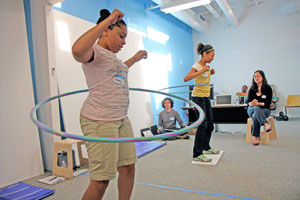
Children face challenges every day.
Many children have chronic illness issues with little personal power to improve the situation. That’s where Redwood City-based HopeLab helps. The nonprofit aims to use research to create ideas that improve the lives of chronically ill children. Success hinges on the input of children and their families, an important part of HopeLab’s scientific process. HopeLab’s work was recently recognized by President Barack Obama as an example of social work that should be supported by both government and private business. So far, it’s been the partnerships and support of both organizations and individuals from a number of different disciplines that have led HopeLab to success.
Aiding with diseases is more than painkillers and medication, said HopeLab President and CEO Pat Christen. Giving children and families a voice and an understanding can help, she said.
Founded in 2001 by Pam Omidyar, who continues to serve as board chair, HopeLab identified five areas — cancer, obesity, sickle cell disease, major depressive disorder and autism — in which there are significant unmet needs for children. HopeLab works with experts in a wide range of fields — including research, psychology, game development, nutrition, communication, health law and policy and organizational development — in its effort to meet those needs.
Essentially, HopeLab wants to ensure there is scientific evidence that anything developed actually helps children before releasing a product to the public, explained Christen. The trick is finding a business model to support the social effort.
The approach caught the eye of professionals in a variety of fields.
"I got involved with [HopeLab] because of a friend, … but I continue working with them because of their evidence-based approach to social innovation (i.e. commitment to formative research and to scientific outcomes studies to measure product efficacy) and our customer-focused development process. They are truly innovative, and one of the smartest nonprofits with whom I work,” said Jennifer Aaker, General Atlantic professor of marketing at Stanford University.
Beating cancer
HopeLab began focusing on cancer first, with the idea of creating a video game which allows kids to take on and beat the disease.
Omidyar approached Gary Dahl, who works in the pediatric hematology/oncology department at Lucile Packard Children’s Hospital, who thought it was a good idea with the resources to move forward.
Dahl watched as the game grew and changed over four to five years into the role-playing game released last year known as Re-Mission. In the game, players control a robot named Roxxi who travels through fictional cancer patients’ bodies taking out cancer cells and battling side effects of both cancer and its treatments.
A study of Re-Mission included 375 teens and young adults with cancer at 34 medical centers in the United States, Canada and Australia over three months. Results showed participants who played the game maintained higher levels of chemotherapy in their blood and took antibiotics more frequently than those in the control group. In addition, Re-Mission players became more knowledgeable about the disease faster.
Dahl noted he comes across many teens and youth who do not believe they need to take medication and was excited to see such results. However, he noted the patients and families must choose to play the game. He does recommend it, but it’s up to them to use it.
Aaker pointed out how the game helped people look at cancer in a different light.
"Playing Re-Mission changes the associations one has with cancer,” she said. "Before playing Re-Mission, a subject has starkly negative associated with cancer; after playing Re-Mission — those associations are less negative, partly because their perceptions of chemotherapy have changed from negative to positive. And there is a tight association between chemo and cancer. So when you start feeling that chemo is a powerful tool, something that you possess — it becomes more positive, and in turn makes cancer seem less negative.”
Re-Mission is available for download or can be ordered online at www.re-mission.net. The game is available in English, Spanish and French and is free for young people with cancer and their families. A $20 donation is suggested for others interested in getting a copy of the game. Development is currently underway for the second version of Re-Mission. The original version works with PCs. Dahl hopes the second version can be used with Macintosh computers as well.
Childhood obesity
In the summer of 2006, HopeLab began to work on ideas of how to improve the battle against obesity.
It began with a nationwide contest to get ideas from kids which HopeLab could use as a starting point.
"There were great kernels in each of these terrific ideas,” said Christen.
It was clear an incentive was needed. An accelerometer of sorts, something that measures movement, was the end result. Called the gDitty, it is designed to increase physical activity for 11- to 14-year-olds as a way to curb childhood obesity. The wearable activity monitor tracks and saves information about the movement of those wearing it. Activity data can be uploaded onto a corresponding Web site, earning the youngster points that can be redeemed for rewards.
Recommended for you
Before the group could create a product, it needed to understand the audience it was trying to reach.
HopeLab partnered with Daylight Design and the Robert Wood Johnson Foundation creating profiles of tweens, children 11 to 14 years old. What they found are eight categories of children when it comes to physical activity ranging from natural, self-motivated athletes to those who either choose not to or are unable to participate in physical activities.
The process, called design thinking, allows the program to be designed around parameters set by the children’s own interests and needs, explained Sven Newman of Daylight. Daylight also holds focus groups with children and families as testing progresses.
One thing they found was the desire by people to have group activities related to the activity challenge. Children were using Web cams to coordinate playing Wii video games, he said. Recently, they were working on finding ways to give greater weight to individual improvement to a child’s level of activity, said Newman.
Siblings Jackie and Richard Ross, 14 and 12 respectively, both gave wearing the gDitty a try. The Ross’ acted as "kid experts” for HopeLab testing the pager-size device.
Neither was very active prior to using the gDitty. Once using the gDitty, their success levels varied.
Jackie was interested at first, but once she hit some technical difficulties and lost points, she lost interest as well. Despite this, Jackie said she used to not play much with her brother, something that changed with the use of gDitty.
Richard ran circles, literally, around his sister as they walked to and from school to earn additional points. He also ran up and down stairs after class and cleaned his house to earn points.
When Ross first got the gDitty, he was unsure of how to use it, and forgot to sign in before going for a run.
"I ran for nothing,” he said to laughs.
Pilot studies show about a 35 percent increase in moderate to vigorous physical activities — equal to running about three-quarters of a mile per day — in those wearing it, said Christen.
Fred Dillon, director of product development for HopeLab, noticed another anecdotal change — a conversation starter about healthy habits for families and communities. Dillon estimated gDittys could be available to the public in late 2010 or early 2011.
National attention
Next, HopeLab hopes to begin early work on major depressive disorder. Like each project that came before, it will be a long, research-based process.
HopeLab’s approach is getting noticed nationally.
In April, Obama signed the Edward M. Kennedy Serve America Act, part of which included a $50 million social innovation fund. Melody Barnes, director of the Domestic Policy Council and the innovation team will begin evaluating nonprofits nationwide. In late June, Obama highlighted four nonprofits leading the way in this field, including HopeLab.
"The bottom line is clear: Solutions to America’s challenges are being developed every day at the grass roots — and government shouldn’t be supplanting those efforts, it should be supporting those efforts. Instead of wasting taxpayer money on programs that are obsolete or ineffective, government should be seeking out creative, results-oriented programs like the ones here today and helping them replicate their efforts across America,” Obama said in his June 30 speech.
Obama further challenged private businesses to partner with the government by providing seed money for ideas to benefit local communities.
"If we work together — if we all go all-in here — think about the difference we can make,” Obama said. "Think about the impact we could have with just the organizations represented in this room.”
For more information about HopeLab visit www.hopelab.org. Donations can be made online.
Heather Murtagh can be reached by e-mail: heather@smdailyjournal.com or by phone: (650) 344-5200 ext. 105.








(0) comments
Welcome to the discussion.
Log In
Keep the discussion civilized. Absolutely NO personal attacks or insults directed toward writers, nor others who make comments.
Keep it clean. Please avoid obscene, vulgar, lewd, racist or sexually-oriented language.
Don't threaten. Threats of harming another person will not be tolerated.
Be truthful. Don't knowingly lie about anyone or anything.
Be proactive. Use the 'Report' link on each comment to let us know of abusive posts.
PLEASE TURN OFF YOUR CAPS LOCK.
Anyone violating these rules will be issued a warning. After the warning, comment privileges can be revoked.