
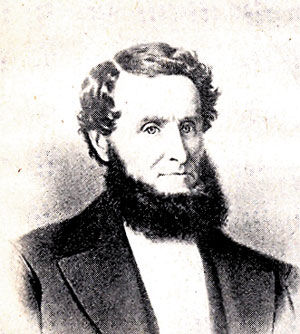
He was an honest, industrious man, of much common sense, though noted for many eccentricities and whims and in his later years, of irritable and thoroughly disagreeable temperament. His great and well-merited fame rests on the final disposition of his millions, which after provision for his relatives, were devoted to various scientific, charitable and educational enterprises for the benefit of the donor’s adopted state.
James Lick, age 21, had been keeping company with a girl named Barbara Snavely. Born in Stumpstown (now Fredericksburg), Penn., James had been become an apprentice in woodworking at age 13. His father dictated this move. One did not argue with a father’s decisions in the early 1800s. He learned fast and, in time, became as skilled as his father. When Barbara announced to James she was pregnant, he decided to do the right thing and marry her. Her father, miller Henry Snavely, disagreed. Only when James had a mill as prestigious and successful as he had in Pennsylvania, could James marry his daughter. As James stomped out of Henry’s house, he shouted, "I will own a mill and make yours look like a pigsty.”
James left Stumpstown and found work in Baltimore making pianos. Before long, he was an expert in this field and opened a shop in New York. In 1821, he found out most of his pianos were sent to Brazil so he decided to go to Buenos Aires and open a shop and make the pianos there. Political unrest and illness led him to leave Brazil and, for a short time, he lived in Europe. On his return trip to Brazil, he was captured by a Portuguese Man-O-War and imprisoned. After escaping, he returned to Brazil, established his fortune and decided in 1832 that he had enough money to woo Barbara back and marry her. His return to Pennsylvania, carrying $40,000 in cash, was disappointing, however, as he could not find his son or mother. She had married shortly after Lick had left in 1821 and, when she heard he was back, left town to avoid him.
The saga continues: Lick returned to Argentina, then moved to Chile and, after a short time, moved to Peru. The newspapers were full of information on the spat between America and Mexico and Lick decided to make a move to California where he felt opportunity for success was ripe for those who chose to go after it.
He arrived in San Francisco in January 1848. With his tools and $30,000 in Peruvian gold and 600 pounds of chocolate, he immediately set about making his fortune. He sold the chocolate and advised a man he met, Domingo Ghirardelli, to market sweets as he felt the market needed a confectioner.
James Lick felt the time was right to buy real estate. There were only a few hundred people living in San Francisco and he could not have known that gold would change his life within the year. He bought every piece of land he could lay his hands on. When the announcement of the gold strike near Sacramento only 17 days after his arrival, he knew he had done the right thing. Masses of people arrived to the little town of San Francisco and he sold land at exceedingly inflated prices. He became rich beyond his wildest dreams. Leaving the day-to-day operation of selling land in San Francisco to an agent, he focused his life on a piece of a land he owned on the Guadalupe River north of San Jose. He planted orchards and grew grain for the market and began building the largest and finest mill that would make Snavely’s mill "look like a pigsty.”
In 1855, he sent for his 37-year-old son John to live in California. He had never met his son and Lick found out when John arrived that his mother had died. As it turns out, John was not suited for business and, after attempting to become a father to him, Lick built a mansion in San Jose. This didn’t help solidify the bond between them and John returned to the East. Lick resided in the empty mansion, sleeping on a door suspended between barrels and drying fruit to eat in the empty unfurnished rooms of the mansion.
Recommended for you
Late in 1861, Lick began building a large hotel at Sutter and Montgomery streets. It was to become not the largest hotel built in San Francisco, but it was of the highest quality. It was three stories high and spanned two blocks. It offered 164 rooms and provided a reading room, a parlor, a marvelous dining room, a bar with billiard rooms and a barbershop. It became the destination of San Francisco high society. It was destroyed in the fire that followed the earthquake of 1906.
Lick was not a well-dressed man, and he didn’t care. After hearing some criticism of his dress written in a newspaper in San Jose, he withdrew an offer of a Conservatory of Flowers to the city and sold the complex to the Golden Gate Park Committee. It now resides in Golden Gate Park. After hearing his son John neglected his parrot, Lick cut much of his fortune he promised him out of his will. He offered to a stranger a 60-acre field for free if the stranger built a wooden fence around it. But the offer was withdrawn when the stranger took a day to reply. These eccentricities set Lick apart from the crowd.
When Lick reached 77 years old, he suffered a stroke in Santa Clara. He returned to San Francisco to live in his hotel. He spent the following years disposing of his fortune. The crowning touch of generosity came when he offered to construct an observatory on top of Mount Hamilton, to the east of San Jose.
James Lick died on Oct. 1, 1876.
Rediscovering the Peninsula by Darold Fredricks appears in the Monday edition of the Daily Journal.







(0) comments
Welcome to the discussion.
Log In
Keep the discussion civilized. Absolutely NO personal attacks or insults directed toward writers, nor others who make comments.
Keep it clean. Please avoid obscene, vulgar, lewd, racist or sexually-oriented language.
Don't threaten. Threats of harming another person will not be tolerated.
Be truthful. Don't knowingly lie about anyone or anything.
Be proactive. Use the 'Report' link on each comment to let us know of abusive posts.
PLEASE TURN OFF YOUR CAPS LOCK.
Anyone violating these rules will be issued a warning. After the warning, comment privileges can be revoked.