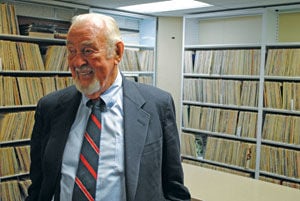
Dan Odum, former College of San Mateo telecom instructor and founding faculty member of KCSM, reminisces about the old days amidst the station's stacks of vinyl LPs
Dan Odum, former College of San Mateo telecom instructor and founding faculty member of KCSM, reminisces about the old days amidst the station's stacks of vinyl LPs
After half a century of educating and entertaining the Bay Area from its studio below the College of San Mateo library, KCSM TV is closer than ever to being auctioned off to a private buyer.
The FCC pushed for the sale of the KCSM TV bandwidth and, in 2013, the San Mateo County Community College District Board of Trustees approved a deal with LocusPoint Networks, which would have LocusPoint subsidize the station in the amount of $900,000 a year for up to four years. In that time, the district is hearing bids in hopes of finding a suitable buyer. The expected price of the station is about $10 million, which will be split between CSM and LocusPoint with the school getting 63.5 percent of the sale, KCSM and school officials said.
While the TV station’s days are numbered, its longtime radio counterpart, KCSM FM, will live on.
The little studio currently broadcasts jazz music programming from FM 91.1 as it did in the beginning, and selections from various public television programming providers on channel 43.1, but the KCSM of today is barely recognizable, at least behind the scenes, from the ambitious pair of college stations it was when it started.
“When Doug Montgomery was the new manager of the broadcast facility here, Dr. Jake Wiens was the dean of the technician division and it was his dream to have radio and television on campus,” said Dan Odum, former CSM telecom instructor and founding faculty member of KCSM. “There was no other school in the state of California except, I think, Riverside that had actual on-the-air stations.”
When Montgomery, Wiens and Odum commenced classes in August of 1964, the purpose of KCSM was educational. The majority of the programming was student-produced. It was such a novelty that the CSM bookstore had to sell tuners so that people could watch the television station. The broadcast provided invaluable opportunities for the students to learn professional-level skills before entering the job market.
“Knowing that there’s someone five miles away watching what you’re doing or listening to what you’re playing puts a pressure on you that’s very real,” Odum said. “I wanted them to be totally prepared when they walked out of here, and that worked extremely well. The KCBS chief engineer said to me, if you have any student who goes through your program that is good and you want to send them out into the industry you call me first because they come in knowing what to do.”
Things began to change in the late ’70s. Less and less television programming was coming from the students and more was being sourced from American public television providers as the studio vied for larger audience appeal. These days KCSM television broadcasts only a handful of student-produced programs each semester. The radio station continues to pump out jazz standards, but no longer are amateurs behind the mic or the switchboard. Students are invited to observe the operations of both studios, and to use the facilities and equipment for classes, but are not involved in the day-to-day activities.
“As far as I understand, the broadcast program and the academic broadcast courses are totally separate other than we’ve had lots of wonderful support from the broadcast engineers,” said Michelle Brown, associate professor of broadcast and electronic media at CSM.
CSM still prides itself on having a top-level broadcast school, despite students not having that real-world experience of running a studio.
Recommended for you
“San Francisco State has a nationally reputable program and they don’t have a TV license, so it’s certainly not unusual at all,” Brown said.
Still, the studio experience that the students received in KCSM’s early days was a uniquely successful endeavor.
“If you take a good 10,000-foot view of it to see the people that are out there employed right now (from CSM’s broadcasting school) that’s the magic of it,” said Chris Phillips, KCSM radio engineer, who graduated from CSM in 1977. “There were a lot of places that if you just said KCSM you were ahead of the game in the employment opportunities.”
The studio broadcasts may not be necessary for the success of the school, but when Odum and Weins first threw the switch and started transmitting in October 1964, it got a lot of young students fired up about broadcasting, and those students are now inspiring the next generation with their work.
Matt Elmore has been the voice for all things KQED since 1987, 10 years after he graduated from CSM’s broadcasting school.
Jon Miller, Baseball Hall of Fame honoree and play-by-play announcer for the San Francisco Giants graduated from CSM in 1971 after cutting his teeth announcing college sports.
“He was 17 years old when showed up at the beginning of one of my classes,” Odum said. “I don’t know how he got in because he wasn’t out of high school yet, but he knew that we had a radio station on the air and that we were going to be doing football and he just wanted to do play by play, and I had the pleasure of being the first person to put (Miller) on the air.”
Though KCSM TV is still looking for a stay of execution, and the radio station is still very much alive, the glory days of KCSM may in fact be gone. As the connection between the station and the curriculum fades, and the auction of the frequency looms, the story of KCSM TV will soon be relegated to the shelves of history like so many program reels in the library basement.
If the station wishes to stay alive, it may need to take one more lesson from Odum’s book of broadcasting.
“It’s a job. It’s hard work,” Odum said. “You’ve got to learn a lot and you’ve got to know a lot and you’ve got to be willing to, at times, sacrifice. We always used the adage ‘you save the show.’ Whatever happens, save the show.”
Keep the discussion civilized. Absolutely NO
personal attacks or insults directed toward writers, nor others who
make comments. Keep it clean. Please avoid obscene, vulgar, lewd,
racist or sexually-oriented language. Don't threaten. Threats of harming another
person will not be tolerated. Be truthful. Don't knowingly lie about anyone
or anything. Be proactive. Use the 'Report' link on
each comment to let us know of abusive posts. PLEASE TURN OFF YOUR CAPS LOCK. Anyone violating these rules will be issued a
warning. After the warning, comment privileges can be
revoked.
Please purchase a Premium Subscription to continue reading.
To continue, please log in, or sign up for a new account.
We offer one free story view per month. If you register for an account, you will get two additional story views. After those three total views, we ask that you support us with a subscription.
A subscription to our digital content is so much more than just access to our valuable content. It means you’re helping to support a local community institution that has, from its very start, supported the betterment of our society. Thank you very much!






(0) comments
Welcome to the discussion.
Log In
Keep the discussion civilized. Absolutely NO personal attacks or insults directed toward writers, nor others who make comments.
Keep it clean. Please avoid obscene, vulgar, lewd, racist or sexually-oriented language.
Don't threaten. Threats of harming another person will not be tolerated.
Be truthful. Don't knowingly lie about anyone or anything.
Be proactive. Use the 'Report' link on each comment to let us know of abusive posts.
PLEASE TURN OFF YOUR CAPS LOCK.
Anyone violating these rules will be issued a warning. After the warning, comment privileges can be revoked.