“San Bruno is at least 1,080 years old.” This age has just been established for the oldest house foundation yet found in San Bruno. The foundations were found by a group of anthropologists from San Francisco State University who have been digging by the banks of San Bruno Creek. A report on some of their findings is in the “La Peninsula,” the monthly publication edited by F.M. Stanger of the San Mateo County Historical Association.
This group was led by archeologist Stanley Van Dyke and by Robert Schenk, curators of the Teganza Anthropology Museum of San Francisco State University. In the 1960s, Schenk had appeared before the San Bruno City Council and pleaded for a delay in development of the land on the western part of the Avansino Mortenson Company flower growers on Sneath Lane (across from the Golden Gate Cemetery) so the group would have time to excavate the ruins of an Indian village. He explained that digging must be done carefully and slowly, with each finding cautiously removed and classified.
With the city’s permission, they received the delay needed from the Alpha Land Co. which was moving in now to build its apartment complex on Cherry Avenue and Sneath Lane. These apartments’ construction would destroy forever any evidence of San Bruno’s oldest neighborhood. Alpha, however, not only cooperated with the archeologists, the firm even provided a grant to help complete the work.
The group of scientists along with donated help from enthusiastic high school student Emile Hons uncovered various artifacts that enabled them to uncover and put together a picture of life of these early San Brunans.
The archeologists named their small village SMa-100, although old data indicated that the site could have been either one of two villages called “Tule-me” and “Ure-bure.” This name became changed by Americans to Buri-Buri and its name exists only in a store complex in South San Francisco by the corner of El Camino Real and Westborough Boulevard that covers a former creek. They called themselves the Ohlones, and vestiges of their civilization are found throughout the Peninsula to San Jose. However, there was only a minimum of contact with each group that numbered at least 10,000 from San Francisco to Monterey.
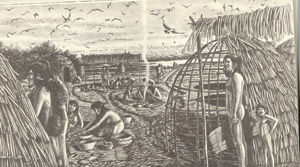
The Indians left no evidence of a written language, use of the wheel or iron and, unlike other families in the area, they practiced communal cooking. That proved they had the use of fire and understood it was necessary for cooking and warmth. Their food fare was limited to birds (ducks were plentiful), fish, oysters, as well as bears, deer, whales occasionally where found on the beach, as well as products made from the plentiful acorns found in the area. The acorns were collected and carried to their village in woven baskets and other containers they invented. Successful hunts were accomplished by use of the bow and arrow. Fish were caught in fish nets or by hand as they were plentiful in creeks during the mating and migration season.
Recommended for you
Two house foundations were found along the San Bruno Creek that passes under Interstate 280 now. They used hard-packed mud and clay which produced a smooth, hard surface four inches thick which lasted over the centuries. Archeologists believe that the house consisted of a shallow pit with a compacted floor and was fashioned with small poles found along the creeks, and these were covered by reeds and brush in a “tepee” fashion. Each year, they had to be remade as the reeds rotted fast during the rainy season.
Scientists deduced all of this and more from rather unimpressive artifacts of shards, broken pottery, fragments of pestles, mortars, hammer stones, charmstones and primitive utensils. This is hard, back-breaking, monotonous work day in and day out, and all of the artifacts are taken back to the lab and sorted out and classified and studied. It’s no Raiders of the Lost Ark fantasy world. It’s pure drudgery. From bones, the Ohlones carved awls, pins and needles, as well as whistles made from a bird’s leg bone. Abalones, olivella and clam shells were fashioned into pendants, beads and other decorations traded and worn to distinguish their stature in the community.
A burial ground was later found along the creek that flows down from the land to the west of the City Park on Crystal Springs Avenue. It appears that the burial area was large and occupied along Crystal Springs Road from St. Roberts Church, west to where the Senior Center complex is located. Dozens of bodies were found then reburied to preserve the findings that will have to be excavated at a later date.
Schenk reports that research on these early-day Peninsula residents had only begun, and that he expects to have fuller reports with more information in the near future. He only hopes that archeologists will be able to preserve some record of our first Peninsula residents from encroaching suburbia.
Rediscovering the Peninsula by Darold Fredricks appears in the Monday edition of the Daily Journal.
Keep the discussion civilized. Absolutely NO
personal attacks or insults directed toward writers, nor others who
make comments. Keep it clean. Please avoid obscene, vulgar, lewd,
racist or sexually-oriented language. Don't threaten. Threats of harming another
person will not be tolerated. Be truthful. Don't knowingly lie about anyone
or anything. Be proactive. Use the 'Report' link on
each comment to let us know of abusive posts. PLEASE TURN OFF YOUR CAPS LOCK. Anyone violating these rules will be issued a
warning. After the warning, comment privileges can be
revoked.
Please purchase a Premium Subscription to continue reading.
To continue, please log in, or sign up for a new account.
We offer one free story view per month. If you register for an account, you will get two additional story views. After those three total views, we ask that you support us with a subscription.
A subscription to our digital content is so much more than just access to our valuable content. It means you’re helping to support a local community institution that has, from its very start, supported the betterment of our society. Thank you very much!







(0) comments
Welcome to the discussion.
Log In
Keep the discussion civilized. Absolutely NO personal attacks or insults directed toward writers, nor others who make comments.
Keep it clean. Please avoid obscene, vulgar, lewd, racist or sexually-oriented language.
Don't threaten. Threats of harming another person will not be tolerated.
Be truthful. Don't knowingly lie about anyone or anything.
Be proactive. Use the 'Report' link on each comment to let us know of abusive posts.
PLEASE TURN OFF YOUR CAPS LOCK.
Anyone violating these rules will be issued a warning. After the warning, comment privileges can be revoked.