
Mika Sasaki spent time as a teen speaking to others about the signs of abusive relationships.
But when the 20-year-old from South San Francisco met a cute guy at college in January 2010, things she knew were red flags were put aside. His family often questioned her safety. He expressed anger easily. Shortly after meeting, it was pretty serious though. Within a month, violence started. It began with jealousy over a text message from an ex, escalating to Sasaki being pushed around.
"I didn’t know what to do, but I knew I needed to call someone,” she said.
Sasaki locked herself in her room and used Facebook to tell a friend she needed help. Police were called. Sasaki didn’t tell the police her boyfriend hit her, however. Things continued to escalate until Sasaki had to request, and was granted, an emergency restraining order. At school, he still showed up and yelled at her. This turbulent reality continued after the couple broke up. Police were called multiple times and, at one point, her ex was thought to have broken into Sasaki’s home.
Earlier this year, Sasaki got the best birthday gift — her ex was locked up.
"Knowing he was in custody was a miracle. I could not sleep. I didn’t feel safe. I had to be walked from my house to my car. I couldn’t go to the library. I didn’t feel safe,” she said.
Unfortunately, Sasaki’s story is not unique. February marks Teen Domestic Violence Awareness Month.
"One in four teens report being in an abusive relationship. That’s way too high,” said Cori Manthorne, director of programs for CORA — Community Overcoming Relationship Abuse. "We think of it as an adult issue. But being in an abusive relationship as a teen increases the likelihood of being in one as an adult.”
Breaking that cycle comes down to education — a goal for many individuals and local organizations.
The challenge, Manthrone said, is most teens turn to peers for support. With that in mind, offering information to youth becomes more important. Locally, CORA has staff that goes to schools for presentations. More recently, teens have contacted the nonprofit wanting to help.
Burlingame High School senior Maria Porter was one of those teens.
"When I discovered CORA, as a survivor of (domestic violence), I knew I had to join them and their efforts to end domestic violence. Now I’m in training to be a certified volunteer,” she said.
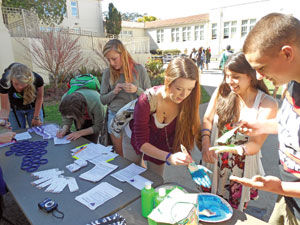
Last week, Porter hosted a pledge to end teen violence at Burlingame High School. Students were asked to paint their hand and place a hand print on the canvas.
"I like the idea of a wall of hand prints because I want to the finished product to look like a wall of ‘helping hands.’ By signing the pledge, an individual is promising to speak out against violence, treat their relationships with respect and care and to fight for the cause of ending domestic violence,” Porter said. "I also think the art piece is a good idea because, instead of a number, it’s a visual to see how many Burlingame students signed the pledge.”
Recommended for you
Porter had more than 200 signatures and also a number of honest conversations with students. Some shared their own personal thoughts about violence while others honestly declined to sign, saying they simply couldn’t follow the request.
Avoiding domestic violence starts with respect. Sasaki said everyone should expect respect and no one deserves to be hit or abused. If that happens, reach out to those who can help. Sasaki had nothing but praise for local police and friends and family who stepped up to offer her support.
Ultimately, "no one deserves to live in fear,” she said.
Info box
Do you need information about domestic violence? There are wonderful resources available online or by phone 24 hours a day.
Love Is Respect — Loveisrespect.org offers information as well as options to chat online, text loveis to 77054 to text or call (866) 331-9474.
CORA — Corasupport.org offers information on abuse and local services as well as a 24-hour hotline: (650) 312-8515 or (800) 300-1080.
INOBTR ("I Know Better”) — INOBTR.org offers information, tips about online safety and resources for parents and teens.
California Adolescent Health Collaborative — www.californiateenhealth.org is a public-private statewide coalition of individuals and organizations that works to increase understanding and support of adolescent health and well-being in California.
StarVista — San Carlos-based organization offers a youth crisis line, (650) 367-9687 and a 24-hour crisis line, (650) 579-0350. It offers a teen website with chat room at www.onyourmind.net.
Heather Murtagh can be reached by email: heather@smdailyjournal.com or by phone: (650) 344-5200 ext. 105.







(0) comments
Welcome to the discussion.
Log In
Keep the discussion civilized. Absolutely NO personal attacks or insults directed toward writers, nor others who make comments.
Keep it clean. Please avoid obscene, vulgar, lewd, racist or sexually-oriented language.
Don't threaten. Threats of harming another person will not be tolerated.
Be truthful. Don't knowingly lie about anyone or anything.
Be proactive. Use the 'Report' link on each comment to let us know of abusive posts.
PLEASE TURN OFF YOUR CAPS LOCK.
Anyone violating these rules will be issued a warning. After the warning, comment privileges can be revoked.