

A large, unmarked mausoleum stands proudly overlooking the Bay in San Mateo’s St. John’s Cemetery. The sarcophagus inside bears a striking resemblance to that of Napoleon’s.
The descendants of the deceased must have felt this person was worthy of a magnificent tomb. So, who occupies this mausoleum and what do we know of that person?
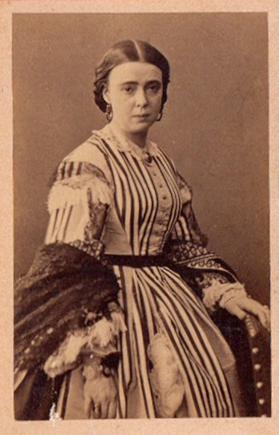
Agnes Poett
Agnes Poett, for whom the mausoleum was built, left a remarkable legacy on the Peninsula but not much is known about her today. Even in her 1893 San Francisco Chronicle obituary we do not learn much about her, other than that she had three husbands and that they were wealthy. Indeed, her first husband is described as “one of the wealthiest men” in California. Husband No. 2 was Husband No. 1’s brother. Husband No. 3 was “a practicing attorney of this city (SF) being considerably her junior.”
However, clues left behind, including personal letters and family histories, fill out the life of this remarkable woman. She first stepped onto San Francisco soil in June of 1849 at the beginning of the Gold Rush as a 16-year-old traveling with her family from her home in Valparaiso, Chile. Meeting the incoming vessels was merchant William Davis Merry (W.D.M.) Howard, a wealthy widower. Howard gallantly escorted Agnes, her father Dr. Poett, and her two sisters and brother off the ship.
Within earshot of Agnes, he told a companion “I am going to marry that beautiful young lady.”
And, indeed, within three weeks of their arrival, the 16-year-old Agnes married the 30-year-old Howard on July 9, 1849. At least that is the story that has been handed down through the family. Others believe the marriage was an arranged one. Valparaiso was a frequent stop of merchants, including Howard, who traveled by ship up and down the western continental seaboard.
The marriage did not last long. W.D.M. died in January 1856 at the age of 36. A widow with a young son, Agnes remarried within two years. Husband No. 2 was W.D.M.’s younger brother George. We know that this marriage “caused a great deal of talk” because the San Francisco business agent of F.A. Atherton wrote to Atherton in Valparaiso on Oct. 19, 1857, and included this gossip among his business news:
“The only item of local news is the marriage of Mrs. Howard to George Howard, which took place on Saturday morning at 9 a.m., after which the happy pair started for Napa Springs where they will remain some days. This marriage has caused a good deal of talk and it is generally considered as a ‘marriage of convenience.’ Dr. Poett [Agnes’ father] is by no means satisfied with the marriage, which has deranged [sic] his plans; it is said that he returns to Europe by this steamer.”
Whether a “marriage of convenience” or not, George and Agnes remained married for 21 years until his death in 1878 and the marriage produced four children. Although the couple maintained a presence in San Francisco, it was during her marriage to George Howard that Agnes began to make San Mateo County a true second home. Home base was “El Cerrito” a gingerbread home that reputedly had been brought in pieces around the Horn. In the early 1860s, the couple donated land and building materials for St. Matthew’s Episcopal Church. They honored W.D.M. by entombing him in a huge stone monument in the entryway of the church — impossible for a visitor to miss. The church was totally rebuilt after the 1906 earthquake. Today, the monument is hidden out-of-sight behind the organ.
The English-looking stone church must have been an unusual sight in the 1860s, surrounded by dirt fields and barren hills. In the next decade, George and Agnes Howard tackled the problem of those barren, dusty hills. Enjoying the wealth left to them by W.D.M. Howard, they made several trips to Europe. During one of these trips, the couple made a decision that would change the look of the Bay Area for the next 150 years: In 1872, they hired the Scotsman John McLaren to be the gardener for El Cerrito.
Recommended for you
For the next 14 years, McLaren lived on the Howards’ property and began to transform the Peninsula. According to McLaren’s family histories, his “mission at El Cerrito was to transmute a wasteland into a Garden of Eden.” His “specific task at the rancho was to ‘create a landscape similar to those seen in Europe.’” Agnes did not get Versailles, but what she got was equally beautiful. McLaren planted thousands of trees on the Howards’ estate and elsewhere, including the plantings along the curved streets of San Mateo Park and early Hillsborough. Just a couple years after his arrival, some of the Howards’ neighbors met at the Howard home to discuss lining the County Road (El Camino Real) with trees. The towering rows of blue gum eucalyptus that McLaren and his men planted are still enjoyed by Peninsula residents today; sadly, most of these 150-year-old trees will soon be removed as part of the Caltrans Renewal Project of El Camino Real.
George died in 1878, just five years after McLaren came to California. A widow once again, Agnes did not remain one for long. In 1879, she married Henry P. Bowie, a San Francisco lawyer who at the age of 31, was 15 years younger than his bride. Indeed, he was only two years older than her first-born child, William H. Howard.
After her third marriage, the newlyweds took an extended honeymoon to Europe with Agnes’ four children from her marriage to Husband No. 2 in tow. While they were gone, their California property was left in the care of her son William, her brother Alfred Poett, and John McLaren.
McLaren’s letters to the family traveling abroad were sunny and full of detailed descriptions of life at El Cerrito.
In 1880, he wrote Agnes’ son George, who by then was 16 years old, “If you were here right now you would like it very much, I am sure. The place looks the brightest green, the oaks just leafing out and the light tea green of the white oak harmonizing with the darker oaks and bays.”
In a more businesslike letter to Bowie, McLaren wrote: “I am looking forward to having the seeds from the Jardin des Plantes and expect some rare varieties, also to seeing the plan of the garden at the Palace of Versailles. I am glad our waterfall compares so favourably with those famous ones you have seen.”
It is clear from the correspondence that Agnes was also very involved with the gardening projects at El Cerrito. In another letter from McLaren to Bowie, McLaren wrote: “I will fulfill my promise of writing to Mrs. Bowie soon and will send a list of the shrubs and trees she ordered me to propagate for that purpose.” Violets were Agnes’ favorite flower and McLaren created a violet garden for her. While abroad she sometimes described being “homesick for her violets.”
John McLaren continued to work for the Bowies for almost a decade, leaving in 1887 to become superintendent of Golden Gate Park — a post he held for more than 50 years. Agnes died six years later in 1893. Husbands No. 1 and 2 are buried inside St. Matthew’s Episcopal Church in San Mateo. However, Agnes converted to Catholicism when she married Henry Bowie. As a result, she is entombed in the large mausoleum at St. John’s Cemetery. Her 29-year-old architect son, George H. Howard Jr., helped his stepfather Henry Bowie design Agnes’ neoclassical mausoleum with its ionic columns, perhaps inspired by the family’s earlier honeymoon trip to Europe. Soon after his mother’s death, George built a country home at the top of Roehampton Road and created a beautiful formal garden — the kind which Agnes always admired. He called his garden “Versailles.”
If there were any doubt of the great affection that McLaren had for Agnes it was dispelled nearly two decades after her death at the Panama Pacific International Exposition. The California Building designated a day for each of California’s counties to showcase something that made their county special. Bowie was in charge of “San Mateo Day” at the Fair, held on Feb. 25, 1915. As a surprise for Bowie, McLaren arranged to have the walls covered with Agnes’ favorite flower — the fragile and exquisite violet. Tons of violets with the dew still on them were brought in from Colma that morning. Visitors streamed in all day to see the flower walls and each visitor — 12,000 in all — was given a bunch of violets as a memento. As McLaren’s biographer wrote, “it was seen as a piece of horticultural wizardry, but it was also a magnificent ‘beau geste’ made to the memory of Mrs. Bowie.”
McLaren continued to serve as superintendent of Golden Gate Park until his death in 1943. His signature look of towering eucalyptus, Monterey cypress and redwoods can be seen throughout Golden Gate Park and San Mateo County. If Agnes Poett Howard Bowie had never desired to create a more beautiful home and majestic gardens, McLaren might never have come to the Bay Area to work his magic. Some 150 years later, we can now look back and see Agnes and her gardener McLaren as two of the many Gold Rush immigrants who helped transform a lawless, dusty, dry California frontier into an expansive example of beauty and culture on the world stage.
Joanne Garrison is a board member of the Burlingame Historical Society and the author of “Burlingame Centennial: 1908-2008.”






(0) comments
Welcome to the discussion.
Log In
Keep the discussion civilized. Absolutely NO personal attacks or insults directed toward writers, nor others who make comments.
Keep it clean. Please avoid obscene, vulgar, lewd, racist or sexually-oriented language.
Don't threaten. Threats of harming another person will not be tolerated.
Be truthful. Don't knowingly lie about anyone or anything.
Be proactive. Use the 'Report' link on each comment to let us know of abusive posts.
PLEASE TURN OFF YOUR CAPS LOCK.
Anyone violating these rules will be issued a warning. After the warning, comment privileges can be revoked.