
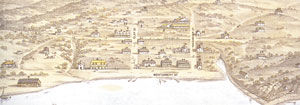
California was in a state of flux in the 1840s. Of course, it was not quite a state of this nation but events such as the 49er gold strike turned this little problem around quickly.
William D.M. Howard, an unruly son of a prosperous New England maritime merchant, left the East when he was 16 and landed in San Francisco four years later. He went into business for himself but about 1845 he formed a partnership with Henry Mellus in a two-story building they acquired from the Hudson Bay Company. The building was on Montgomery Street, right on the edge of the Bay a block or so away from W.A. Leidesdorff’s warehouse. Leidesdorff Street is named for him. Howard also got a street named after him south of Market Street. His drive rewarded him with wealth and influence. The two-story building sat right across the street from the Yerba Buena Cove shore where Howard could be the first to check ships coming into the Bay for available merchandise. It was while he was doing this duty that he met and married 16-year old Agnes Poet.
The matter of the Hudson Bay Company (HBC) building is intriguing when researched farther as it is tied up with a great deal of history about the western settlement in the 1820s, ’30s and ’40s. The HBC was incorporated by British royal charter in 1670 as The Governor and Company of Adventures of England trading into Hudson’s Bay. It is the oldest commercial corporation in North America and encompasses 1.5 million square miles surrounding the Hudson Bay in Canada. Named Rupert’s Land, it formed its headquarters on the Hudson Bay at York Factory (Factory is a term relating to the "factor” that was the head of the fort and acted as a mercantile agent). HBC formed a network of trading posts in this virgin territory and encouraged trappers and traders to collect furs and sell them to the agents at the posts. It exercised a virtual monopoly from Hudson Bay and the surrounding territory. Conflict arose over the British and French and the posts became battle zones for many years, however the HBC prevailed in the long run and prospered.
In 1870, the British government overthrew the monopoly of HBC in the Northwest Territory and this opened trade to any entrepreneur. UBC established a fort at Fort Vancouver on the Pacific Coast and began fur trade south into the unclaimed northern territory that was later to become Washington, Oregon and California. Competition in the early 1800s began between the westward movement of people from the United States and the "westward expansion of Manifest Destiny” became challenged.
UBC sent "trapping brigades” south from Vancouver and established posts in this territory. Called the "Siskiyou Trail,” big risks were encountered and the fur trade began feeling the economic loss from being overextended from their base in Canada. They had built a trading building on Yerba Buena Cove on the Peninsula in this expansion time but, by the 1840s, it became unprofitable. Howard arrived in time to buy this piece of property from HBC and establish a mercantile business that served the 49er Gold Rush. He prospered greatly.
Recommended for you
The HBC became retailer merchants in Canada and finally relinquished the role of fur trading. It now has four retail divisions: The Bay, Zellers (department stores), Home Outfitters and Fields establishments as well as being into credit card business, mortgages and personal insurance mainly in Canada. It is now owned by a billionaire American. In 2011, U.S.-based Target stores purchased lease agreements for use of up to 220 Zeller stores in Canada and in 2014 plan on opening its first Target stores in Canada.
Howard and Mellus acquired the 6,438-acre Rancho San Mateo and after buying Mellus out, Howard, rich from real estate dealings and a leading civic figure on the Peninsula, retired from his partnership from Henry Mellus around 1850.
Howard began construction on his estate of the mansion, El Cerrito, in the San Mateo/Hillsborough area. The family donated land for St. Matthew’s Episcopal Church in San Mateo and he developed his estate into a prosperous cattle ranch. In 1856, at the age of 37, William died after contacting pneumonia. His brother, George, then married his widowed wife, Agnes, and the Howard/Poett family continued to contribute to the Peninsula’s history.
Rediscovering the Peninsula by Darold Fredricks appears in the Monday edition of the Daily Journal.




(0) comments
Welcome to the discussion.
Log In
Keep the discussion civilized. Absolutely NO personal attacks or insults directed toward writers, nor others who make comments.
Keep it clean. Please avoid obscene, vulgar, lewd, racist or sexually-oriented language.
Don't threaten. Threats of harming another person will not be tolerated.
Be truthful. Don't knowingly lie about anyone or anything.
Be proactive. Use the 'Report' link on each comment to let us know of abusive posts.
PLEASE TURN OFF YOUR CAPS LOCK.
Anyone violating these rules will be issued a warning. After the warning, comment privileges can be revoked.