Twenty-four year old Eugene Ely sat in his flying machine as he calculated the wind and observed the weather. The weather had been bad, but the rain had stopped and the wind had let up a little. “The ship is running on a flood-tide,” someone said.
Ely, a farm boy from Iowa, had been crazy about all mechanical things, especially automobiles. After moving to California, he established himself as one of the best mechanics and car drivers on the West Coast. He loved the speed and the challenge of racing. While in Oregon, his wife Mable, whose sister lived in San Bruno, had told Eugene of a Curtiss aircraft on display in Portland. It was a 1,000-pound “pusher” aircraft that aviator and inventor Glenn Curtiss had put on display, but it was not for sale. Ely talked the salesman into selling it, however, and he immediately taught himself the fundamentals of flight, put the plane into shape to fly and took off into the air. Before long he was “barnstorming” throughout the northwest, making as much as $1,000 per performance. A lot of money at the time.
Ely met Glenn Curtiss in Minnesota one day, and Curtiss signed him on with the Curtiss Air Shows. While in Virginia to see an air show, Ely met Naval Captain Washington Irving Chambers who was in charge of aviation matters for the Navy. Ely convinced Chambers that taking off from a ship was entirely possible and Ely accomplished this feat from the USS Birmingham in November 1910.
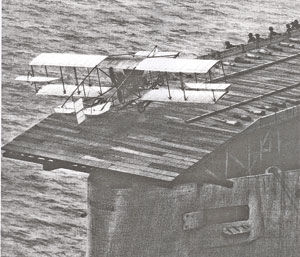
Ely felt that landing on a ship was also possible and, while in San Francisco in January 1911, he convinced the Navy to let him attempt this feat on the armored cruiser USS Pennsylvania. The ship was outfitted with a 120-by-32-foot wooden landing platform at Mare Island. Strips of rope were strung across the platform and tied to canvas bags full of sand that were to stop the aircraft by means of a metal hook anchored to the bottom of the plane. A canvas tarp was strung up at the end of the platform in case the plane overshot the landing area. Ely’s plane was modified so the wings were longer, and a pair of metal tanks were secured underneath to float the plane in case the pilot ended up in the Bay.
After the rain stopped, Ely felt it was now or never for the flight. He had prepared himself for this moment and he was now ready. The plane was ready. He took off into the wind from the Tanforan race track center field. He headed north to the Hunter’s Point area and turned right. He was now over the Bay and again headed north to rendezvous with the USS Pennsylvania.
Recommended for you
All of a sudden he flew into an area of fog and he lost his bearings. The ship was not in view as he continued north. Suddenly the air was clear again, and he sighted the ship with her nose pointed toward the Golden Gate. The captain of the ship, Captain Pond, and Ely had determined that pointing the bow into the wind toward the Golden Gate would create the best conditions for the landing. Even so, Ely was apprehensive about the crosswinds that might send him into the ship’s bow or into the water if it blew him to the north.
He had to calculate as he was flying which area to land the plane on — to the left of center of the ropes, right of center of the ropes, or in the center of the ropes. He chose to land to the right of center. He slowed the plane down to 40 mph as he descended from 400 feet to about 100 feet and then he leveled off. He approached the ship and suddenly decided to go around the ship before coming in again. The ship’s deck was full of people who wanted to see the first landing of a plane on a ship. The people were crowded everywhere on the deck. That made him nervous as he began getting his plane ready to make the landing. He turned off the engine and began his glide onto the deck.
The wheels made contact, the hook caught the ropes intended to stop him, and the plane’s forward momentum stopped. There was a period of silence on the ship and then the crowd broke out in a cheer. Ely had made the first landing onto a naval ship.
Ten years later, the first ship to be used as an aircraft carrier was built. Naval warfare would be changed forever.
Rediscovering the Peninsula by Darold Fredricks appears in the Monday edition of the Daily Journal.Photo courtesy of the San Mateo County History Museum
Keep the discussion civilized. Absolutely NO
personal attacks or insults directed toward writers, nor others who
make comments. Keep it clean. Please avoid obscene, vulgar, lewd,
racist or sexually-oriented language. Don't threaten. Threats of harming another
person will not be tolerated. Be truthful. Don't knowingly lie about anyone
or anything. Be proactive. Use the 'Report' link on
each comment to let us know of abusive posts. PLEASE TURN OFF YOUR CAPS LOCK. Anyone violating these rules will be issued a
warning. After the warning, comment privileges can be
revoked.
Please purchase a Premium Subscription to continue reading.
To continue, please log in, or sign up for a new account.
We offer one free story view per month. If you register for an account, you will get two additional story views. After those three total views, we ask that you support us with a subscription.
A subscription to our digital content is so much more than just access to our valuable content. It means you’re helping to support a local community institution that has, from its very start, supported the betterment of our society. Thank you very much!



(0) comments
Welcome to the discussion.
Log In
Keep the discussion civilized. Absolutely NO personal attacks or insults directed toward writers, nor others who make comments.
Keep it clean. Please avoid obscene, vulgar, lewd, racist or sexually-oriented language.
Don't threaten. Threats of harming another person will not be tolerated.
Be truthful. Don't knowingly lie about anyone or anything.
Be proactive. Use the 'Report' link on each comment to let us know of abusive posts.
PLEASE TURN OFF YOUR CAPS LOCK.
Anyone violating these rules will be issued a warning. After the warning, comment privileges can be revoked.