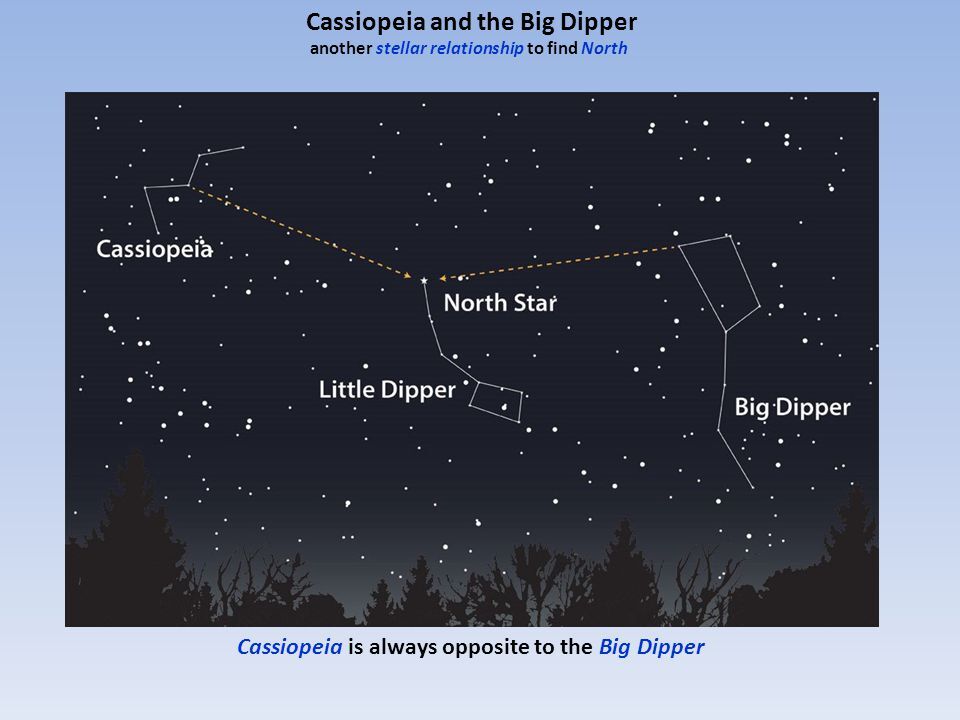
If you recall from last week, we’re observing the Cassiopeia constellation. It’s visible all night however my observations are from about 45-minutes to one-hour after sunset. It usually takes about 20 minutes for stars (or sometime planets) to start appearing. So it’s best to stargaze at least 30-minutes after sunset. So again, we’re going to use the outside of the “bowl” of the Big Dipper to find Polaris, also known as the North Star.
So face east and look for the Big Dipper, looking almost like a question mark. It’s always best to do stargazing from a dark spot but travelling to a dark spot isn’t necessary. Even with all the light pollution, the Big Dipper is easily visible. We’re going to use the top two stars to find Polaris. Draw a line using the two top stars towards Polaris. Then on the other side of Polaris, is Cassiopeia looking like a sideways W.
According to Constellation-Guide.com, the stars, from top to bottom, are Segin or Epsilon Cassiopeiae, Ruchbah also known as Delta Cassiopeiae, Gamma Cassiopeiae, Schedar or Alpha Cassiopeiae and Caph, also called Beta Cassiopeiae.
As promised last week, we will take a closer look at each star in this constellation. Once again, we’ll start from the top with Segin or ε Cassiopeiae, Epsilon Cassiopeiae is approximately 440 light years away. It is 2,500 times more luminous than the sun! Segin is notable for showing extremely weak spectral absorptions of helium.
Ruchbah or δ Cassiopeiae, Delta Cassiopeiae is an eclipsing binary star with a period of 460 days. It is about 99 light-years away. It is the fourth brightest star in the constellation. The star’s traditional name, Ruchbah, comes from the Arabic rukbah, which means “the knee.” Sometimes the star is also known as Ksora.
Gamma Cassiopeiae or γ Cassiopeiae is the central star in the W shape and currently the brightest star in the constellation. It is about 610 light years away, with a luminosity 40,000 times that of the sun’ Its mass is 15 times of the sun. The star rotates very rapidly and bulges outward along the equator. As a result of its fast spinning, a “decretion” disk of lost mass and material forms around the star, causing the fluctuations in luminosity. It is also a known X-ray source.
Recommended for you
The Chinese call the star Tsih, which means “the whip.” It also has the nickname Navi, which it got from the American astronaut Virgil Ivan Grissom – Navi is Ivan spelled backwards. The star was used as a navigational reference point by astronauts. (On Jan. 27, 1967, astronauts Ed White, Roger Chaffee and Grissom climbed aboard the Apollo-I spacecraft command module at Cape Kennedy for a routine “plugs out” test. All three astronauts died in a fire that broke out in the cabin of the spacecraft during the testing. Grissom, White and Chaffee became the first casualties of the U.S. space program, according to NationalAviation.org.)
Schedar (Shedir) or α Cassiopeiae, Alpha Cassiopeiae is approximately 228 light years away. The star’s traditional name, Schedar, is derived from the Arabic şadr, which means “breast.” The name refers to the star’s position, marking Cassiopeia’s heart.
Caph or β Cassiopeiae, Beta Cassiopeiae is only 54.5 light-years away. It is 28 times brighter than the sun and four times the size. Its traditional name is derived from the Arabic kaf, which means “palm” (i.e. palm of the Pleiades or reaching from the Pleiades, the famous cluster in Taurus constellation). The star’s other traditional names are al-Sanam al-Nakah and al-Kaff al-Khadib.
Again, if you recall from last week, Cassiopeia was a queen in ancient Greek mythology. According to legend, she boasted she was more beautiful than the sea nymphs, which angered them. The sea nymphs appealed to Poseidon, god of the sea. He sent a sea monster, Cetus, to ravage the kingdom. To try to appease the Poseidon, Cassiopeia’s daughter, Princess Andromeda, was left tied to a rock by the sea. Cetus was about to devour her when Perseus the hero, who just happened to be passing by while flying on Pegasus, rescued the princess, and all lived happily! This story may sound familiar since it’s the basis for “Wrath of the Titans.”
The gods were so pleased, that all of them were elevated to the heavens as stars. Only Cassiopeia suffered an indignity – her vanity caused her to be bound to a chair and placed in the heavens so that, as she revolves around the north star, Polaris. Sometimes she’s in an upside-down position. It’s then that the Lady of the Chair, as she is sometimes called, is said to hang on for dear life. If Cassiopeia the Queen lets go, she will drop from the sky into the ocean below, where the sea nymphs are waiting.
Look Up appears in the weekend edition. If you have any astronomical questions or facts you’d like to share email news@smdailyjournal.com with the subject line “Look Up.”
Keep the discussion civilized. Absolutely NO
personal attacks or insults directed toward writers, nor others who
make comments. Keep it clean. Please avoid obscene, vulgar, lewd,
racist or sexually-oriented language. Don't threaten. Threats of harming another
person will not be tolerated. Be truthful. Don't knowingly lie about anyone
or anything. Be proactive. Use the 'Report' link on
each comment to let us know of abusive posts. PLEASE TURN OFF YOUR CAPS LOCK. Anyone violating these rules will be issued a
warning. After the warning, comment privileges can be
revoked.
Please purchase a Premium Subscription to continue reading.
To continue, please log in, or sign up for a new account.
We offer one free story view per month. If you register for an account, you will get two additional story views. After those three total views, we ask that you support us with a subscription.
A subscription to our digital content is so much more than just access to our valuable content. It means you’re helping to support a local community institution that has, from its very start, supported the betterment of our society. Thank you very much!








(0) comments
Welcome to the discussion.
Log In
Keep the discussion civilized. Absolutely NO personal attacks or insults directed toward writers, nor others who make comments.
Keep it clean. Please avoid obscene, vulgar, lewd, racist or sexually-oriented language.
Don't threaten. Threats of harming another person will not be tolerated.
Be truthful. Don't knowingly lie about anyone or anything.
Be proactive. Use the 'Report' link on each comment to let us know of abusive posts.
PLEASE TURN OFF YOUR CAPS LOCK.
Anyone violating these rules will be issued a warning. After the warning, comment privileges can be revoked.