
Featured
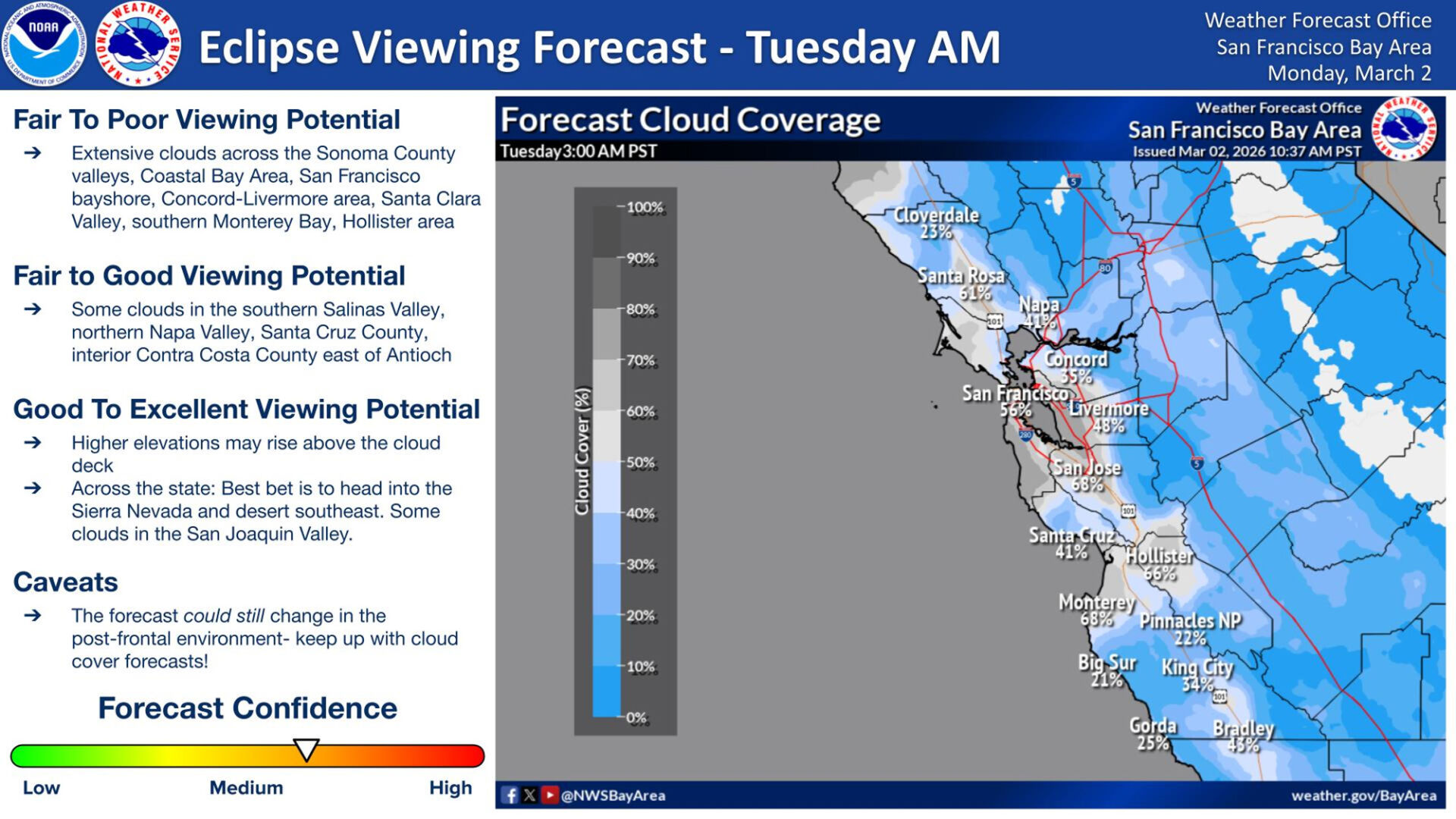
Cloud cover early Tuesday around much of the Bay Area may disappoint those hoping for views of the total lunar eclipse, or Blood Moon, accordi…
Cloud cover early Tuesday around much of the Bay Area may disappoint those hoping for views of the total lunar eclipse, or Blood Moon, accordi…

NASA's Lucy spacecraft will soon swoop past a small asteroid. It will be the second asteroid encounter for Lucy, launched in 2021 on a quest that will take it to 11 space rocks. Its ultimate destination is the unexplored swarms of asteroids out near Jupiter. NASA considers Sunday's flyby a dress rehearsal for 2027 when Lucy reaches its first so-called Trojan asteroid near Jupiter. Looking on from Mission Control in Colorado will be paleontologist Donald Johanson, who discovered the Lucy fossil 50 years ago. The asteroid is named for him.

A new study finds that climate change is already causing all sorts of problems on Earth, but soon it will be making a mess in orbit around the planet too. MIT researchers calculate that as global warming continues it may reduce the available space for satellites in low Earth orbit by anywhere from one-third to 82% by the end of the century. That's because climate change makes the upper atmosphere cooler and less dense. Dead satellites and debris won't fall to Earth as much, which is nature's way of cleaning up what humanity launches. So space will become more littered.

A NASA rover on Mars is tackling a new challenge and climbing to the rim of a crater. The rover called Perseverance started the steep climb Tuesday. It has spent the last 3 1/2 years exploring the bottom of the crater where it landed in 2021. So far, it has collected 22 rock core samples and will pick up more from the top of the crater. The samples may help scientists piece together what the red planet's climate looked like billions of years ago. The rover will scale rocky terrain and slopes of up to 23 degrees on the monthslong journey.
MOUNTAIN VIEW — Astronomers say a bit of science fiction is now reality. They’ve spotted a planet orbiting two suns.
NEW YORK — Stung by concerns that using Google is bad for the planet, the Internet search giant has revealed exactly how much electricity the …

Using a telescope, English astronomer William Herschel (1738-1822) discovered the planet Uranus in 1781. Herschel named the planet the "Georgi…


