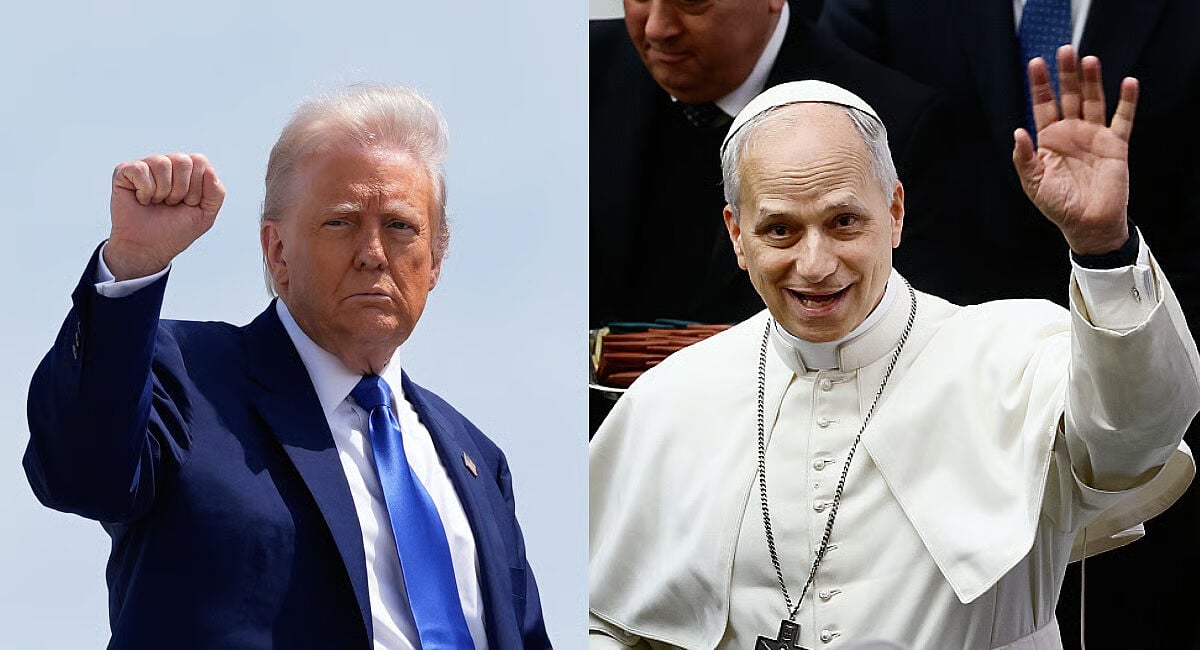
The contrast between President Donald Trump and Chicago-born Pope Leo XIV couldn't be more stark, politically, personally or in their world views. They lead in different roles and realms. But Leo's historic election last week to lead the world's 1.4 billion Catholics as the first U.S.-born pope means that the two most powerful people on the planet are Americans. That raises questions about American influence at a time when Trump's tariff wars and "one way or the other" threats have upended eight decades of global order and sparked distrust among allies toward the U.S. The prospect of too much American power in geopolitics is considered one reason that the Catholic Church had never elected an American to the papacy.
Details have begun to emerge of how votes swiftly coalesced to make Pope Leo XIV history's first American pope. Freed from their conclave, cardinals began describing the hours and days leading up to the final ballot Thursday afternoon that brought Leo past the two-thirds majority needed. Many marveled that the Chicago-born Augustinian missionary in Peru reached the threshold so quickly, given the vast diversity of voters and the traditional taboo against a U.S. pope because of the secular power the country wields. Leo said Friday in his first Mass that his election was both a cross to bear and a blessing.
Black smoke has poured out of the Sistine Chapel chimney, indicating no pope was elected on the first ballot of the conclave to choose a new leader of the Catholic Church. The smoke billowed out at 9 p.m. Wednesday, some four hours after 133 cardinals solemnly entered the Sistine Chapel, took their oaths of secrecy and formally opened the centuries-old ritual to elect a successor to Pope Francis to lead the 1.4 billion-member church. With no one securing the necessary two-thirds majority, or 89 votes, the cardinals will retire for the night to the Vatican residences where they are being sequestered. They return to the Sistine Chapel Thursday morning.
Cardinals have wrapped up their pre-conclave meetings before they enter the conclave to elect a new pope. They are trying to identify someone who could follow Pope Francis and make the 2,000-year-old Catholic Church credible and relevant today, especially to young people. The cardinals held their last day of pre-conclave meetings Tuesday morning during which Francis' fisherman's ring and his official seal were destroyed in one of the final formal rites of the transition of his pontificate to the next.
All Vatican personnel involved in supporting the upcoming papal conclave must take an oath of secrecy — under penalty of automatic excommunication. The ceremony on Monday, mandated by Vatican law and revised by Pope Benedict XVI, includes clerics and lay staff alike: cooks, cleaners, doctors, nurses and security officials. Nearly 135 cardinal electors will gather in the Sistine Chapel, beginning on Wednesday, to vote in secret for Pope Francis's successor. The oath, which explicitly forbids recording or disclosing anything from within the conclave, underscores the Church's insistence on confidentiality. Cardinals are bound by their own rules of secrecy. They will take their oaths on Wednesday.
Three days of public viewing of Pope Francis' body by ordinary mourners and statesmen alike have ended and the pontiff's coffin sealed. Francis died on Monday at age 88 after suffering a stroke. The Vatican said Friday that around 250,000 mourners filed through St. Peter's Basilica over the three days to pay their last respects as Francis lay in state in a simple wooden coffin. Hundreds of disappointed people were turned away when authorities closed St. Peter's Square hours before the viewing period ended. Francis will be buried after a funeral Mass on Saturday.
By NICOLE WINFIELD and COLLEEN BARRY Associated Press
Updated
Vatican News has reported that Pope Francis was thankful that he was able to greet throngs of people in St. Peter's Square on Easter, a day before he died. Although the agency reported Tuesday that he initially had some doubts given his poor health. The Argentine pontiff had been recovering after being hospitalized for five weeks with pneumonia. He died Monday at age 88. He made his last public appearance Sunday, delivering a blessing and looping around Vatican City's famous square in his popemobile.
By NICOLE WINFIELD, TRISHA THOMAS and SILVIA STELLACCI Associated Press
The Vatican says Pope Francis has shown further slight improvement as he battles double pneumonia, but doctors still say his prognosis is still guarded. A CT chest scan taken Tuesday evening showed the "normal evolution" of an infection as it is being treated. Blood tests have confirmed an improvement, according to the Vatican's late update. The slight kidney insufficiency detected a few days ago has receded, and Francis is continuing to receive respiratory physiotherapy. It was the first time the Vatican has said Francis was receiving physiotherapy to help him expel fluid from his lungs. Francis resumed work in the afternoon, after receiving the Eucharist in the morning.
The pope looms so large in everyday Italian life that there are lots of expressions that make light of even a dark event like his death. "A pope dies, they make another," goes one, suggesting how life goes on. His possible successor a matter of intense gossip everywhere, from taxicabs to butchers' shops. Pope Francis' recent bout with pneumonia, which has landed him in the hospital for the fourth time, has fueled more speculation. This time, that's been fueled by the movie "Conclave," which has reminded the world about the arcane rules and spectacular drama involved in a papal election and turned viewers into armchair experts.