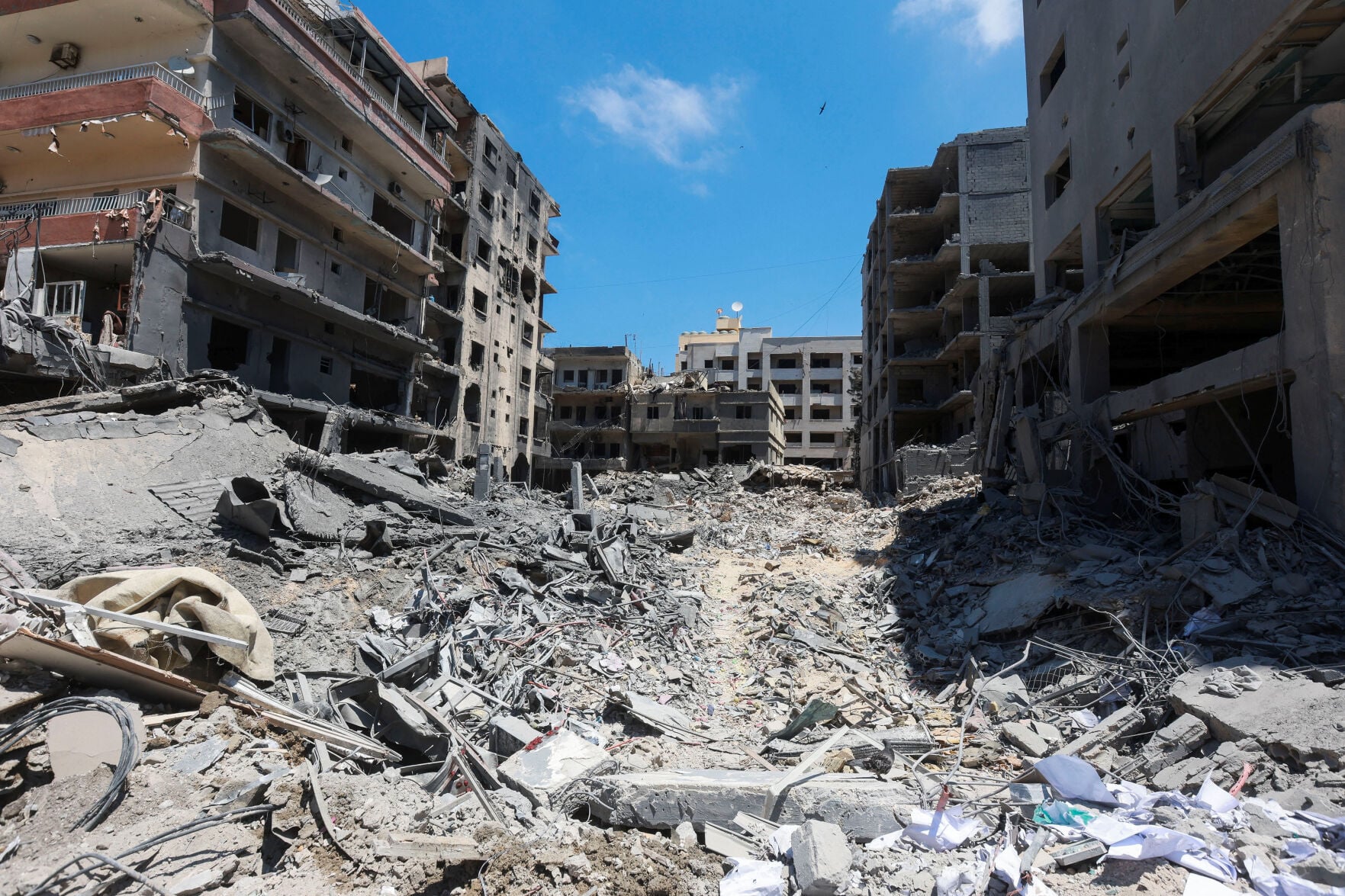
Ceasefires have been announced, often to great fanfare, in Gaza, Lebanon and Iran. But the fighting continues. In just the last few weeks, Israeli forces have captured more territory in Gaza and killed two top Hamas militants there, as well as more than a dozen other people. In Lebanon, Israeli troops captured a Crusader fortress over the weekend in their deepest incursion in 26 years, as Hezbollah kept up rocket fire. The fighting in Lebanon showed no sign of letting up on Tuesday, after U.S. President Donald Trump said both sides had agreed — again — to de-escalate. The United States and Iran have traded fire as they try to reach a more lasting truce.
By JULIA FRANKEL and WAFAA SHURAFA Associated Press
Millions of Palestinians are marking the 78th anniversary of the Nakba. That's Arabic for "catastrophe," referring to the mass expulsion and flight of some 750,000 Palestinians from what is now Israel during the 1948 war surrounding Israel's creation. Friday's anniversary is the third commemoration of the Nakba since the war in Gaza began. More than six months after an October ceasefire, Gaza's more than 2 million people are now crammed into less than half of the 25-mile-long strip along the Mediterranean coast. They are surrounded by an Israeli-controlled zone. Israeli Prime Minister Benjamin Netanyahu says his country's military now controls 60% of the Gaza strip.
Friday marks six months since the ceasefire in Gaza took effect, but progress remains limited. The fighting between Israeli forces and Hamas-led militants has mostly stopped, yet challenges persist. Disarming Hamas, deploying an international stabilization force and beginning reconstruction are pending. The U.S.-created Board of Peace has not met since its initial meeting, and Hamas has not responded to a disarmament proposal. Such challenges could represent what's to come in the latest war in the Middle East, as U.S. President Donald Trump's approach to peacemaking appears to focus on stopping bombardment while leaving the bigger picture for others to work out.
Turkish officials say that gunmen attacked police outside a building housing the Israeli Consulate in Istanbul. The gunbattle left one assailant dead and two police officers wounded. Two other assailants were captured on Tuesday. The attackers carried long-barreled weapons. The area surrounding the building was quickly sealed off. Interior Minister Mustafa Ciftci said that at least one of the attackers was linked to a group he said was "exploiting religion" without naming the organization. Turkish Justice Minister Akin Gurlek said that an investigation has been launched. The consulate is located in a high-rise building.
By WAFAA SHURAFA, TOQA EZZIDIN and CARA ANNA Associated Press
Palestinians in Gaza are reacting to a possible shift in the world's attention away from the Israel-Hamas ceasefire to a new regional conflict with Iran. Israel closed all crossings into the territory of over 2 million people in the wake of its new strikes on Tehran. The Israeli military body overseeing civilian affairs in Gaza said it closed the crossings because they cannot not be safely operated under fire. It said crossings would reopen as soon as the security situation allows. Palestinians fear new lack of access to food and other basic necessities from the outside world. Memories of hunger during last year's Israeli blockade remain fresh. The latest conflict comes days after U.S. President Donald Trump rallied billions of dollars in pledges for Gaza's reconstruction.
A new Gallup poll shows that American sympathies in the Middle East have shifted dramatically toward the Palestinians after decades of overwhelming support for the Israelis. That shift accelerated during the war in Gaza. Fifty-four percent of Americans sympathized more with the Israelis three years ago compared with 31% for the Palestinians. Their support is now about evenly balanced between the Israelis and the Palestinians. The numbers reflect how support for Israel has become deeply contentious in the U.S. with profound implications for American politics and foreign policy. The changing sentiment has been largely driven by Democrats who are now much more likely to sympathize with Palestinians.
By JULIA FRANKEL and NATALIE MELZER Associated Press
Indian Prime Minister Narendra Modi received a rousing welcome from lawmakers in Israel. The Indian leader started a two-day visit on Wednesday with a speech to the Israeli Parliament in which he promised continued "friendship, respect and partnership." Israeli and Indian officials expect the visit to strengthen security, economic and technological cooperation between the allied countries. Israel's Prime Minister Benjamin Netanyahu told Modi he has "never been more moved" by a foreign leader's visit. Modi became India's first prime minister to visit Israel in 2017. This is his second trip, nine years later.
President Donald Trump has announced at the inaugural Board of Peace meeting that nine members have agreed to pledge $7 billion toward a Gaza relief package. He also says five countries have agreed to deploy troops as part of an international stabilization force for the war-battered Palestinian territory. While lauding the pledges, Trump faces the unresolved challenge of disarming Hamas, a sticking point that threatens to delay or even derail the Gaza ceasefire plan that his administration notched as a major foreign policy win. The dollars pledged on Thursday, while significant, represent a small fraction of the estimated $70 billion needed to rebuild the Palestinian territory decimated after two years of war between Israel and Hamas.