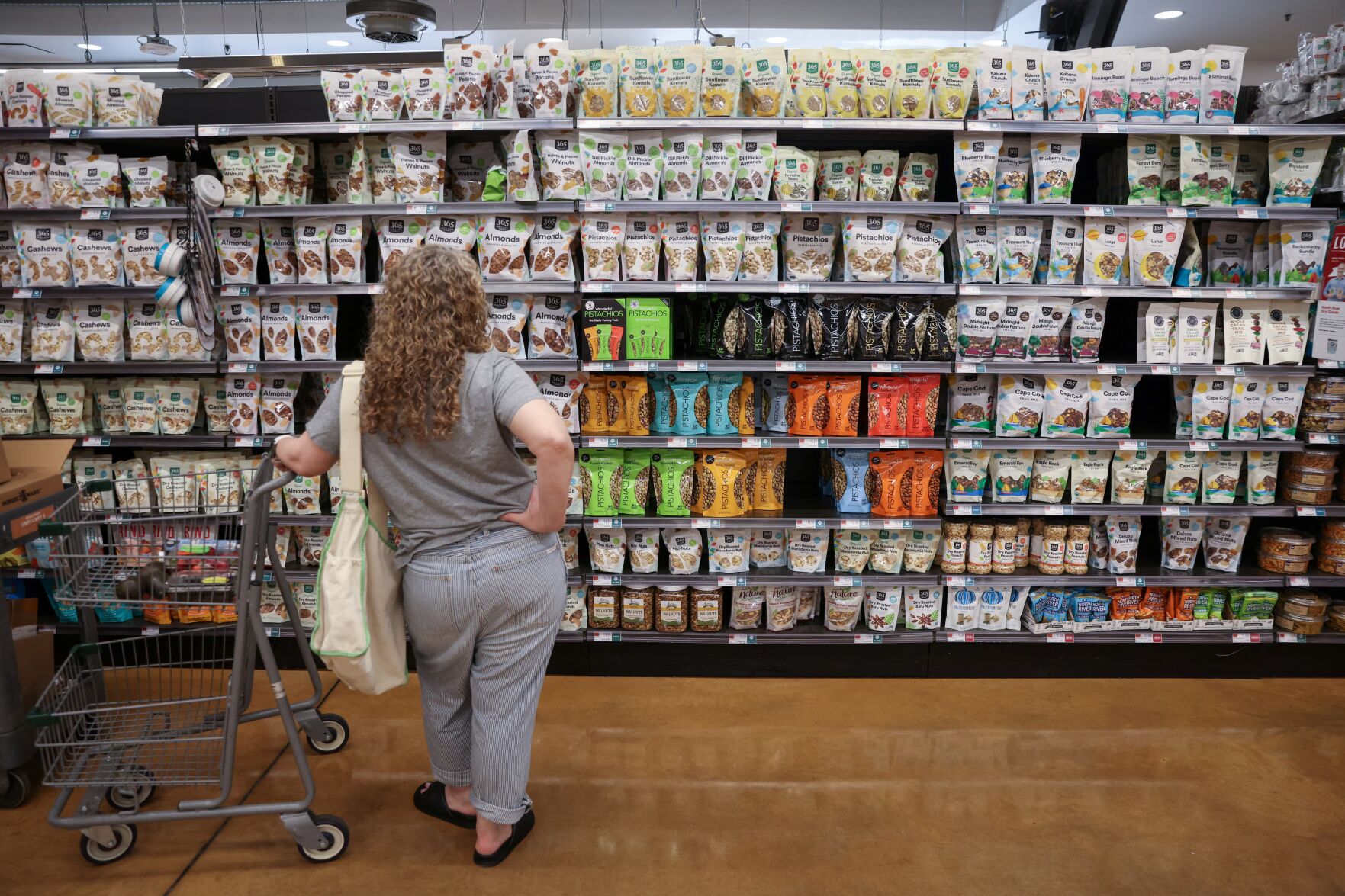
Inflation rose last month to its highest level since February as President Donald Trump's sweeping tariffs push up the cost of a range of goods, including furniture, clothing, and large appliances. Consumer prices rose 2.7% in June from a year earlier, the Labor Department said Tuesday, up from an annual increase of 2.4% in May. Worsening inflation poses a political challenge for Trump, who promised during last year's presidential campaign to immediately lower costs only to engage in a whipsawed frenzy of tariffs. Trump has declared that the U.S. effectively has no more inflation as he has attempted to pressure Federal Reserve Chair Jerome Powell into cutting short-term interest rates.
President Donald Trump says he's reached a trade deal with Vietnam. Trump says Vietnam will pay a 20% tariff on goods sent into U.S. territory and a 40% tariff on transshipping, which usually means exports from China that pass through Vietnam. Trump says the U.S. will have "TOTAL ACCESS" to the Vietnamese market for trade and be able to sell products with no tariff. The Republican president's announcement Wednesday comes as an analysis finds a critical group of U.S. employers would face a direct cost of $82.3 billion from his current tariff plans. The JPMorganChase Institute analysis says the cost could be managed through price hikes, layoffs, hiring freezes or lower profit margins.
The Federal Reserve will continue to wait and see how the economy evolves before deciding whether to reduce its key interest rate, Chair Jerome Powell says, a stance directly at odds with President Donald Trump's calls for immediate cuts. Powell said Tuesday that the economy is in a good position and that the Fed needs to learn more before adjusting rates. Powell is facing two days of what could be tough grilling on Capitol Hill, as Trump has repeatedly urged the Fed to reduce borrowing costs.
By CHRISTOPHER RUGABER and ANNE D'INNOCENZIO Associated Press Writers
U.S. inflation picked up a bit last month as higher prices for groceries and some imported goods were largely offset by cheaper gas, travel services, and rents. Consumer prices increased 2.4% in May compared with a year ago, according to a Labor Department report released Wednesday. That is up from a 2.3% yearly increase in April. The cost of groceries, toys and games, and large appliances rose, which could reflect the impact of President Donald Trump's tariffs. Yet the price of new and used cars, clothes, airfares, and hotel rooms all dropped from April to May, offsetting the increases.
A key U.S. inflation gauge slowed last month as President Donald Trump's tariffs have yet to noticeably push up prices, while American incomes jumped. Friday's report from the Commerce Department showed that consumer prices rose just 2.1% in April compared with a year earlier, down from 2.3% in March and the lowest since September. Excluding the volatile food and energy categories, core prices rose 2.5% from a year earlier, below the March figure of 2.6%. Economists track core prices because they typically provide a better read on where inflation is headed. The figures show inflation is still declining from its post-pandemic spike, which reached the highest level in four decades in July 2022.
A federal appeals court is allowing President Donald Trump to continue collecting tariffs under an emergency powers law for now, as his administration appeals an order striking down the bulk of his signature set of economic policies. The Court of Appeals for the Federal Circuit granted an emergency motion Thursday from the Trump administration arguing that a halt is "critical for the country's national security." The appeals court temporarily halted the order from a federal trade court issued a day before. Trump is facing several lawsuits arguing Trump's "Liberation Day" tariffs exceeded his authority and left the country's trade policy dependent on his whims.
By PAUL WISEMAN and LINDSAY WHITEHURST Associated Press
President Donald Trump is waging a trade war without getting approval from Congress: He declared a national emergency to slap import taxes — tariffs — on almost every country on earth. The president is now facing at least seven lawsuits that argue he's gone too far and asserted power he does not have. The first of the legal challenges went to court Tuesday in New York. Five small businesses are asking a three-judge panel of the U.S. Court of International Trade to block the sweeping import taxes that Trump announced April 2 – "Liberation Day,'' he called it.
Inflation may have picked up slightly last month as President Donald Trump's widespread tariffs kicked in, a trend economists expect will become more visible in the coming months. Tuesday's report could provide an early read on how Trump's duties will affect the prices Americans pay for necessities and other goods such as clothing, shoes, furniture and even groceries. Duties on many goods from Mexico and Canada took effect in February and could have impacted prices last month. Still, economists forecast the impact from duties to be modest.
U.S. President Donald Trump and new Canadian Prime Minister Mark Carney faced off in the Oval Office on Tuesday and showed no signs of retreating from their gaping differences in an ongoing trade war that has shattered decades of trust between the two countries. The two kept it civil, but as for Trump's calls to make Canada the 51st state, Carney insisted his nation was "not for sale" and Trump shot back, "time will tell." Asked by a reporter if there was anything Carney could tell him to lift his tariffs of as much as 25% on Canada, Trump bluntly said: "No." The U.S. president added for emphasis, "Just the way it is."
The International Monetary Fund says the US and global economies will likely slow significantly in the wake of President Donald Trump's tariffs and the uncertainty they have created. The IMF said Tuesday that the global economy will grow just 2.8% this year, down from its forecast in January of 3.3%, according to its latest World Economic Outlook. And in 2026, global growth will be 3%, the fund predicts, also below its previous 3.3% estimate. And the Fund sees the world's two largest economies, China and the United States, weakening.