

Defense Secretary Pete Hegseth has announced that the U.S. military carried out strikes in the eastern Pacific Ocean against four boats accused of carrying drugs, killing 14 and leaving one survivor. The strikes were launched Monday and announced on social media Tuesday. It's the first time multiple strikes have been announced in a single day as the pace of the attacks has escalated. A Pentagon official says the strikes were conducted off the coast of Colombia. However, the Mexican navy says it's searching about 400 miles southwest of the Pacific city of Acapulco, far away from Colombia. It wasn't immediately clear exactly where the strike took place, and the Pentagon didn't give more details.
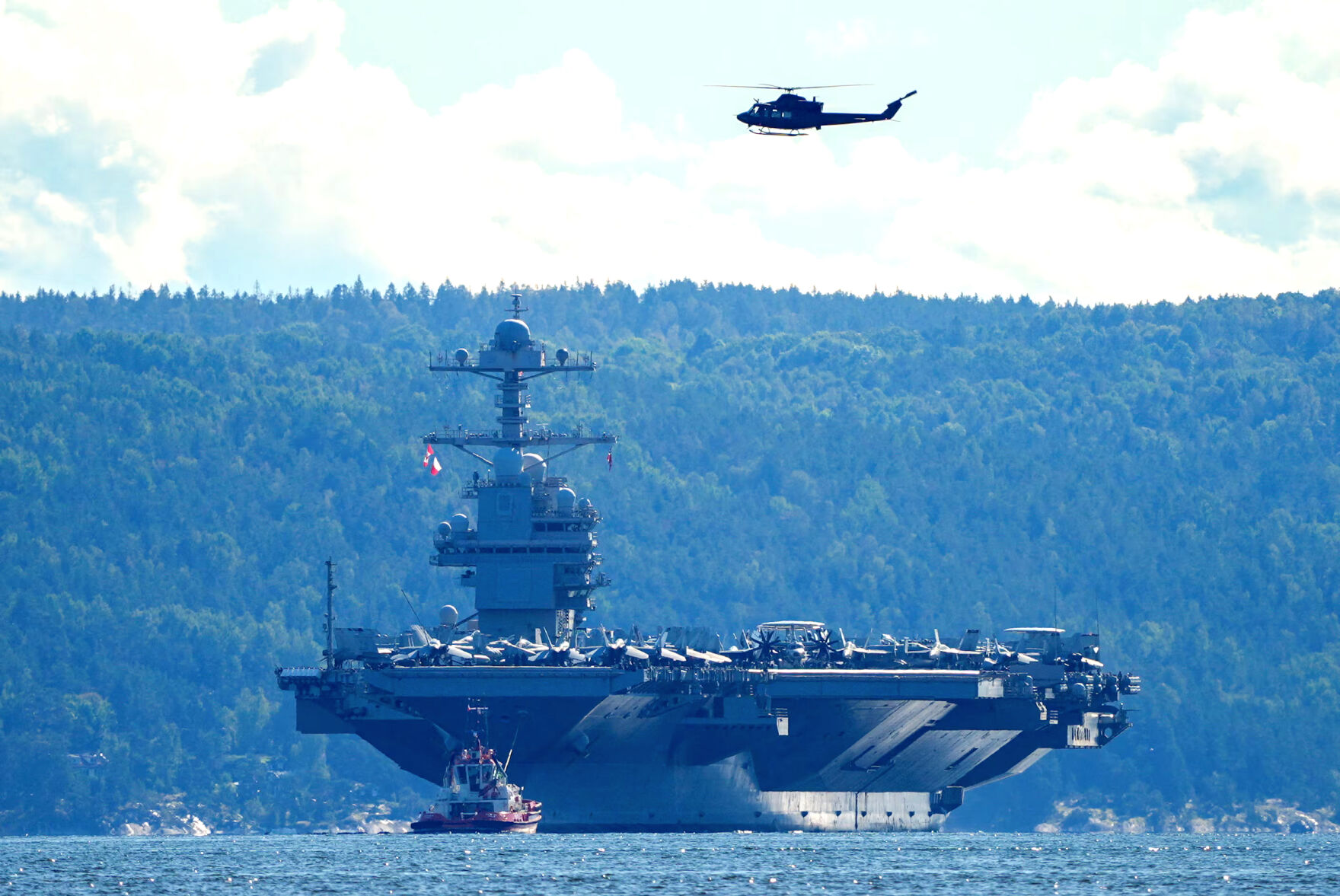
The U.S. military is sending an aircraft carrier to the waters off South America in the latest escalation of military firepower to a region. A Pentagon spokesman said Friday that the USS Gerald R. Ford and its strike group would deploy to the U.S. Southern Command region to "bolster U.S. capacity to detect, monitor, and disrupt illicit actors and activities that compromise the safety and prosperity of the United States." The USS Ford is port in Croatia and it was not clear how long it would take for the strike group to arrive. Earlier Friday, Defense Secretary Pete Hegseth said the military had conducted the 10th strike on a suspected drug-running boat, killing six people.

Legal experts say U.S. strikes against alleged members of Latin American drug cartels are pushing the bounds of international law. Under President Donald Trump, the U.S. military has struck several boats, killing 28 people, after authorities received information suggesting they were carrying drugs. Trump's administration is justifying this use of force by relying on a legal framework created after the Sept. 11, 2001, attacks. That framework allowed authorities to use lethal force against al-Qaida combatants responsible for the attacks on the U.S. The gangs now being targeted in Latin America, however, are a different foe, fueled not by anti-U.S. ideology but by the drug trade.

President Donald Trump has declared drug cartels to be unlawful combatants and says the United States is now in an "armed conflict." That's according to a Trump administration memo obtained Thursday by The Associated Press. A person familiar with the matter who's not authorized to comment publicly says Congress was notified about the designation by Pentagon officials Wednesday. The move comes after the U.S. military last month carried out three deadly strikes against alleged drug-smuggling boats in the Caribbean. At least two of those operations were carried out on vessels originating from Venezuela. The top Democrat on the Senate Armed Services Committees says drug cartels "must be dealt with by law enforcement."

U.S. Defense Secretary Pete Hegseth and Air Force Gen. Dan Caine, chairman of the Joint Chiefs of Staff, have arrived in Puerto Rico as the U.S. steps up its military operations against drug cartels in the Caribbean. The arrival comes more than a week after ships carrying hundreds of U.S. marines deployed to Puerto Rico for a training exercise. Puerto Rico's Gov. Jenniffer González said Hegseth and Caine visited the U.S. territory on Monday to support those participating in the training. The visit comes as the U.S. prepares to deploy 10 F-35 fighter jets to Puerto Rico for operations targeting drug cartels.

Judges in Texas and New York said they would temporarily bar the U.S. government from deporting Venezuelans jailed in parts of those two states while their lawyers challenge the Trump administration's use of a rarely-invoked law letting presidents imprison and deport noncitizens in times of war. The judges took actions Wednesday after civil rights lawyers sought to protect five men identified by the government as belonging to the Tren de Aragua gang, a claim their lawyers dispute. But the judges said some others in their judicial districts similarly situated would also be protected from the Alien Enemies Act-driven deportations.

The Trump administration is touting a Supreme Court ruling allowing it to resume deportations under the Alien Enemies Act as a major victory, but the immigration fight is far from over. The divided court found that President Donald Trump can use the 18th century wartime law to deport Venezuelan migrants accused of being gang members to a notorious prison in El Salvador, a finding Trump called a "GREAT DAY FOR JUSTICE IN AMERICA!" in a social media post. But the justices also decided people accused of being members of the Tren de Aragua gang have to get a chance to challenge their removals — a finding their lawyers called an "important victory."

It's a local threat to some and a full-on invasion to President Donald Trump. Debates over Trump's hard-line migration policies are focused on the ruthless Venezuelan gang Tren de Aragua. Trump labeled the Tren de Aragua an invading force when he invoked the Alien Enemies Act, a 1798 authority that allows the president to deport any noncitizen during wartime. The Trump administration transferred hundreds of immigrants to El Salvador over the weekend even as a federal judge issued an order temporarily barring the deportations. Flights were in the air when the judge issued his ruling.


