As tensions simmered between the United States and Europe over President Donald Trump's push to acquire Greenland, Russian officials, state-backed media and pro-Kremlin bloggers watched with a mixture of glee, gloating and wariness. Some touted Trump's move as historic, while others said it weakens the European Union and NATO — something that Moscow would seem to welcome — and that it pushes Russia's war in Ukraine to the sidelines for the West. Some noted the Arctic island held security and economic concerns for the U.S. Russian Foreign Minister Sergey Lavrov also drew parallels between Trump's bid for Greenland and the annexation of Ukraine's Crimean Peninsula in 2014, which many nations do not recognize as legal.
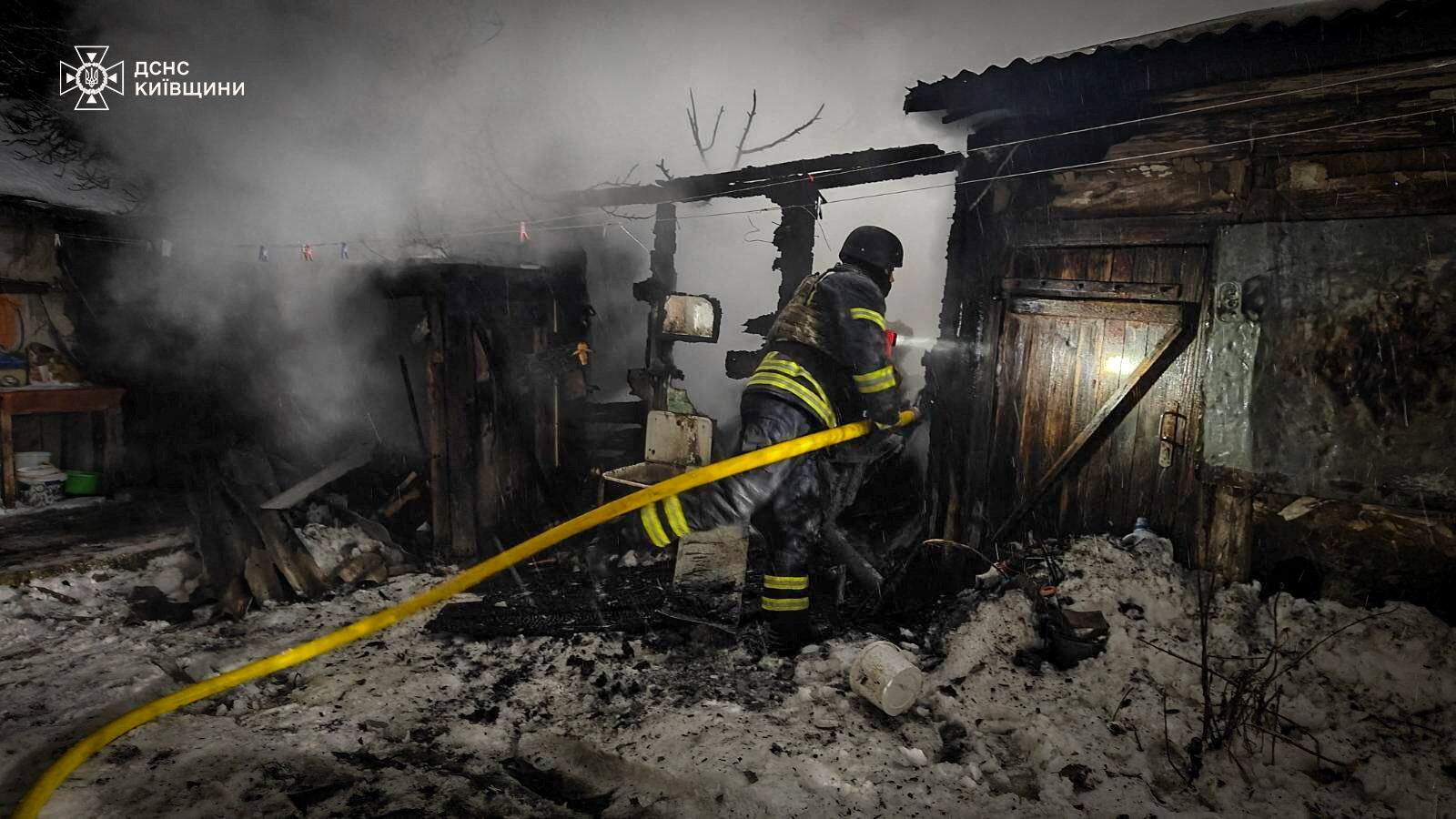
Russia has launched another major drone and missile attack on Ukraine that targeted the country's power grid in freezing temperatures. Ukrainian President Volodymyr Zelenskyy said Tuesday that Russia fired nearly 300 drones, 18 ballistic missiles and seven cruise missiles at eight regions overnight. A strike in the Kharkiv region killed four people. The attack left several hundred thousand households without power in the Kyiv region. Russia launched a similar attack four days earlier in which Moscow used a powerful hypersonic missile. The U.S. has accused Russia of escalating the conflict. Ukraine is seeking quicker air defense deliveries from the U.S. and Europe to counter the attacks.
U.S. President Donald Trump's latest threats against Greenland pose a new and potentially unprecedented challenge to NATO, perhaps even an existential one. The alliance is normally focused on external threats, but it could now face an armed confrontation involving its most powerful member. The White House says the administration is weighing options that could include military action to take control of the strategically located and mineral-rich island. Greenland is part of NATO ally Denmark. Trump's designs on Greenland could put at risk the entire future of NATO, which was founded in 1949 to counter the threat to European security posed by the Soviet Union.
By JOHN LEICESTER and SYLVIE CORBET Associated Press
Ukraine's allies have agreed to provide multilayered defense guarantees to help end Russia's invasion. Leaders from Europe, Canada, the U.S., the EU, and NATO met in Paris to discuss support for Ukraine. They plan to provide equipment, training, and air, land, and sea support. U.K. Prime Minister Keir Starmer said progress was made but challenges remain. Allies will monitor any ceasefire and support Ukraine's defense long-term. Ukrainian President Volodymyr Zelenskyy said commitments need ratification. French President Emmanuel Macron called the security statement a significant step toward peace. Details of the plan remain unclear.
Officials say Ukrainian drone strikes killed two people and wounded two others, including a child, in Russia's Belgorod and Kursk regions on Sunday. More peace talks are expected in Paris early this week. In Ukraine, three people were wounded in overnight drone strikes in the Kharkiv region, and the death toll from Friday's missile attack on Kharkiv rose to five. European and other national security advisers met in Kyiv on Saturday to discuss security guarantees and economic support. Ukrainian President Volodymyr Zelenskyy said meetings of military officials and European leaders in Paris on Monday and Tuesday could finalize security guarantee documents.
Ukrainian President Volodymyr Zelenskyy appointed the head of the country's military intelligence as his new chief of staff. In announcing the appointment of Gen. Kyrylo Budanov, Zelenskyy said Ukraine must focus on security issues, the development of its defense and security forces, and peace talks -- areas that are overseen by the office of the president. Zelenskyy had dismissed his previous chief of staff Andrii Yermak amid an investigation into alleged corruption in the energy sector. Budanov, 39, is one of the country's most recognizable and popular wartime figures. He has led Ukraine's military intelligence agency, known by its acronym GUR, since 2020.
Russia's nuclear-capable Oreshnik missile system has entered active service, Russia's Ministry of Defense says, as negotiators continue to search for a breakthrough in peace talks to end Moscow's war in Ukraine. Troops held a brief ceremony to mark the occasion in neighboring Belarus where the missiles have been deployed, the ministry says. It did not say how many missiles had been deployed or give any other details. The announcement comes at a critical time for peace talks, with negotiators still searching for a breakthrough on key issues, including territory and control of the Zaporizhzhia nuclear power plant.
Ukrainian President Volodymyr Zelenskyy says he would be willing to withdraw troops from the country's eastern industrial heartland as part of a plan to end Russia's war, if Moscow also pulls back and the area becomes a demilitarized zone monitored by international forces. He made the proposal Tuesday in conversations with reporters. It offered another potential compromise on control of the Donbas region, which has been a major sticking point in peace negotiations. Zelenskyy said the U.S. proposed the creation of a "free economic zone," which he said should be demilitarized. But it was unclear what that idea would mean for governance or development of the region.
By SAMYA KULLAB and VASILISA STEPANENKO Associated Press
U.S. proposals for a peace deal between Ukraine and Russia meet many of Kyiv's demands, according to Ukrainian President Volodymyr Zelenskyy. On Monday, he said that while the drafts look solid, neither side is likely to get everything it wants. U.S. envoy Steve Witkoff held productive talks with Ukrainian and European representatives. Meanwhile, Ukrainian forces have struck deep inside Russia, targeting an oil terminal, pipeline, and military assets. These attacks aim to disrupt Russia's war effort. Russia continues targeting Ukraine's energy sector, trying to deprive civilians of heat and water during winter.
By JILL LAWLESS and ILLIA NOVIKOV Associated Press
Updated
British, French and German leaders met in London with President Volodymyr Zelenskyy in a show of European support for Kyiv at what they called a "critical moment" in the U.S.-led effort to end Russia's war in Ukraine. Afterward, British Prime Minister Keir Starmer, Zelenskyy and the other leaders called their European allies to urge them to keep economic pressure on Russian President Vladimir Putin. Zelenskyy earlier said discussions were focused on security, air defense and long-term funding. A spokesman for the British prime minister said "intensive work" will continue, although "outstanding issues" remain. Russia continues to attack Ukraine, killing at least four people, while Russian air defenses destroyed 67 Ukrainian drones overnight.