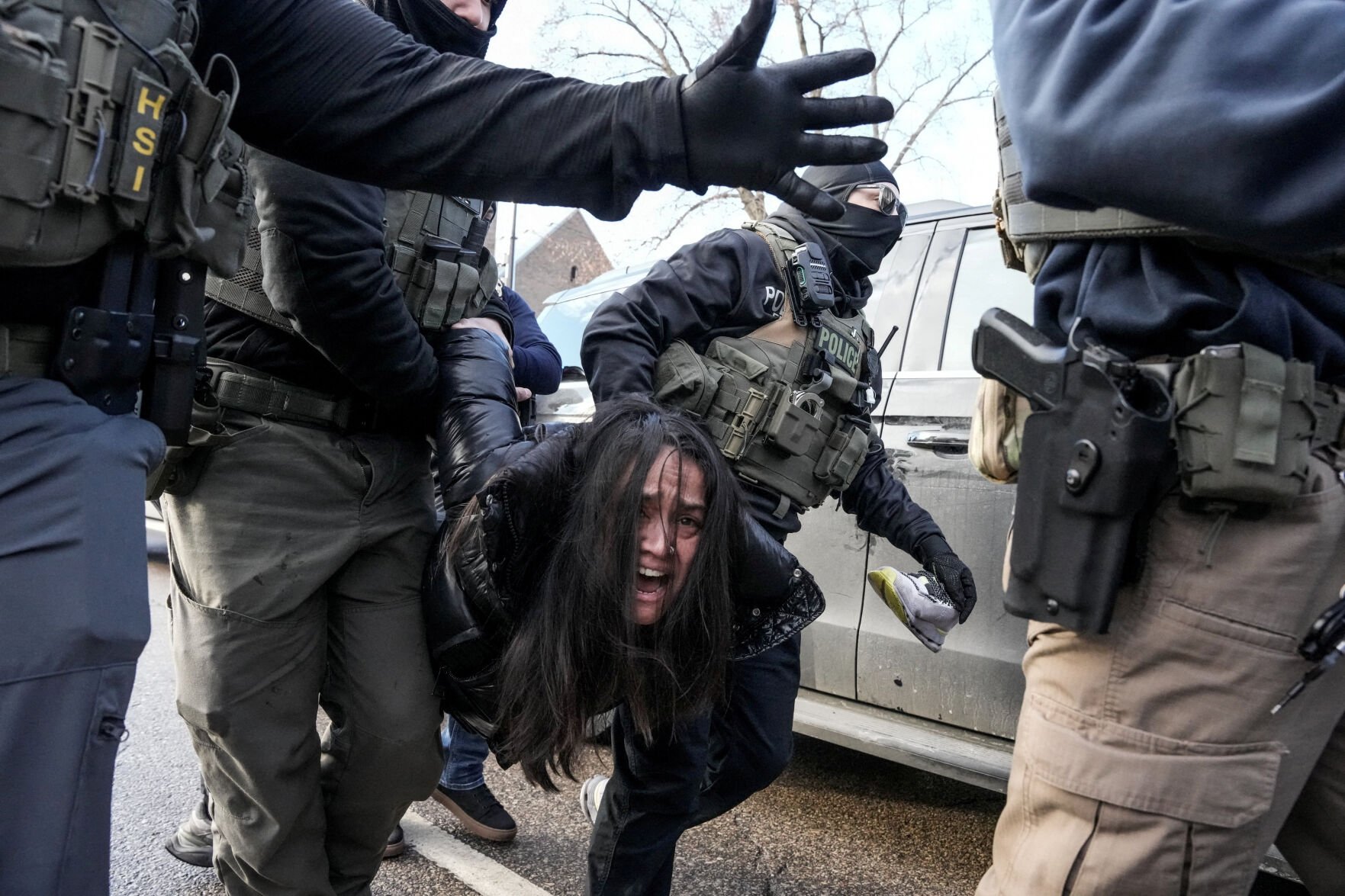
Local leaders across the U.S. describe an increasingly hostile relationship with Washington, driven by President Donald Trump's immigration policies. Federal officers remain in Minneapolis despite local opposition, highlighting the growing divide. Local leaders feel pressured by federal priorities, affecting trust and stability. The tensions have upended longtime Republican arguments that the federal government should leave local governance to the states under the 10th Amendment to the U.S. Constitution. Now a Republican president is articulating a muscular federal approach over the protest of Democrats. Trump has expressed frustration at reflexive resistance from Democratic mayors and governors.
By STEVE KARNOWSKI, JACK BROOK and GIOVANNA DELL'ORTO Associated Press
Updated
President Donald Trump seemed to signal a willingness to ease tensions in Minneapolis after a second deadly shooting by federal immigration agents. But there was little evidence Wednesday of any significant changes after weeks of harsh rhetoric and clashes with protesters. Trump made a leadership change by sending his top border adviser to Minnesota to take charge of the immigration crackdown. That was followed by seemingly conciliatory remarks about the Democratic governor and mayor. But on city streets, there were few signs of a shift. Immigration enforcement operations and confrontations with activists continued in Minneapolis and St. Paul.
By GIOVANNA DELL'ORTO and SARAH RAZA Associated Press
Police arrested anti-immigration enforcement demonstrators at Minnesota's largest airport after they overstepped their permit, officials said, as Arctic temperatures seized the state and others protesting the Trump administration's crackdown urged people to stay away from work, school and shops. One of the faith groups organizing the protest said Friday "roughly 100 clergy" were arrested. Metropolitan Airports Commission spokesman Jeff Lea said the protesters were arrested outside the main terminal of Minneapolis-St. Paul International Airport when they went beyond what their permit for demonstrating stipulated and began affecting airline operations. Meanwhile, groups are asking Minnesotans to stay home in protest at immigration enforcement operations in the state
By MARK VANCLEAVE and TIM SULLIVAN Associated Press
Updated
Days of demonstrations against immigration agents and a new lawsuit have left Minnesota tense. Federal officers sprayed eye irritant and dropped tear gas at a swarm of activists Tuesday in Minneapolis. Students, meanwhile, walked out of a suburban school, part of the ongoing tension over the Trump administration's immigration enforcement sweeps. Minnesota and its two largest cities are suing the government to try to halt or limit the enforcement surge that led to the fatal shooting of a woman last week in Minneapolis.
By REBECCA SANTANA and MARK VANCLEAVE Associated Press
Federal officers in Minneapolis have fired tear gas to break up a crowd of whistle-blowing bystanders who showed up to see the aftermath of a car crash involving immigration agents. The scene Monday was just a few blocks from where an immigration officer fatally shot Renee Good last week. A crowd emerged to witness a man being questioned by agents who rear-ended his car. Agents used tear gas to try to break up the group, then drove off as people screamed, "cowards!" Minnesota's attorney general and the mayors of Minneapolis and St. Paul plan to address the media about the immigration operation.
The wife of the woman shot and killed by a federal immigration officer in Minneapolis says the couple had stopped their car to support their neighbors and they had whistles, while the masked agents had guns. It was the first public comment from Rebecca Good about the death of Renee Good, the mother of three killed Wednesday when three Immigration and Customs Enforcement officers surrounded and tried to force open the door of her Honda Pilot SUV and the vehicle lurched forward. Trump administration officials have painted Renee Good as a domestic terrorist who tried to run over an officer with her vehicle. Rebecca Good described her late wife as a Christian who was trying to build a better world.
The head of the FBI says America is facing heightened threats from many corners at a time when law enforcement agencies are struggling. FBI Director Christopher Wray says he is "hard pressed to think of a time in my career where so many different kinds of threats are all elevated at once." Wray spoke Wednesday in an exclusive interview with The Associated Press while visiting the Minneapolis field office to talk about partnerships between law enforcement agencies and also with other entities. His remarks come as the FBI confronts heightened concerns over domestic and international terrorism, as well as Chinese espionage and intellectual property theft and foreign election interference.