The Trump administration is telling European nations that they need to step up their travel restrictions for people from Ebola-hit countries in Africa. It's warning that failure to do so may result in increased U.S. regulations on travel from Europe, including for the World Cup soccer tournament. The State Department says Secretary of State Marco Rubio called European Commission President Ursula von der Leyen on Tuesday to convey concerns about "U.S. and European coordination and response efforts to the Ebola outbreak." A department official, speaking on condition of anonymity to discuss the private call, was more blunt, saying it's time for action and hinting that without it, transatlantic travel could be affected.
President Donald Trump insists he's comfortable with the current holding pattern in the Iran war. But the Republican president faces warnings from foes and allies alike that he's getting boxed in on a conflict he sold as a quick military incursion. There's growing concern inside the administration and from key advisers and allies Trump now finds himself in a bind. That's according to a U.S. official and another person familiar with the administration's internal deliberations. Trump is buffeted by Democrats looking to seize on surging global oil prices sparked by the war and warnings from hawkish members of his base that an early exit from the conflict would amount to capitulation.
By AAMER MADHANI and SIMINA MISTREANU Associated Press
President Donald Trump has demonstrated greater ambivalence toward Taiwan in his second term. That's raising questions about the Republican president's commitment to maintaining American support for the self-ruled island ahead of this week's summit with Chinese President Xi Jinping. In December, Trump authorized an $11 billion arms package for Taiwan but delayed its delivery and discussed the sale with Xi. Trump said Monday he expects Xi will ask him to hold back on arming Taiwan. Trump has accused Taiwan of "stealing" America's semiconductor business and pressured it to invest in U.S. tech sectors. Analysts say Xi might urge Trump to loosen ties with Taiwan, which Beijing views as its breakaway province.
By MICHELLE L. PRICE and AAMER MADHANI Associated Press
President Donald Trump says the only reason the Iranians are alive today "is to negotiate," as he sends Vice President JD Vance overseas to work on a resolution to the war. Vance is warning Iran not to "play" the U.S. as he heads to Pakistan for talks aimed at ending the 6-week-old conflict. The Republican vice president set off Friday to lead mediated talks with Iran in the Pakistani capital of Islamabad. Vance says he's "looking forward to the negotiation" and thinks it'll be positive. Vance's trip comes as a temporary ceasefire appears to be on the precipice of collapsing.
By MATTHEW LEE and SAMUEL PETREQUIN Associated Press
Deep divisions were apparent over the Iran war as top diplomats from the Group of Seven countries have met in France. But they agreed to call for an immediate halt to attacks against civilian populations and infrastructure after meeting Friday in France. The G7 meeting follows U.S. President Donald Trump's repeated complaints that allies have ignored or rejected requests for help confronting Iran's retaliation, including the closure of the Strait of Hormuz to most international shipping. U.S. Secretary of State Marco Rubio joined his G7 counterparts a day after Trump lobbed his latest round of insults at NATO countries.
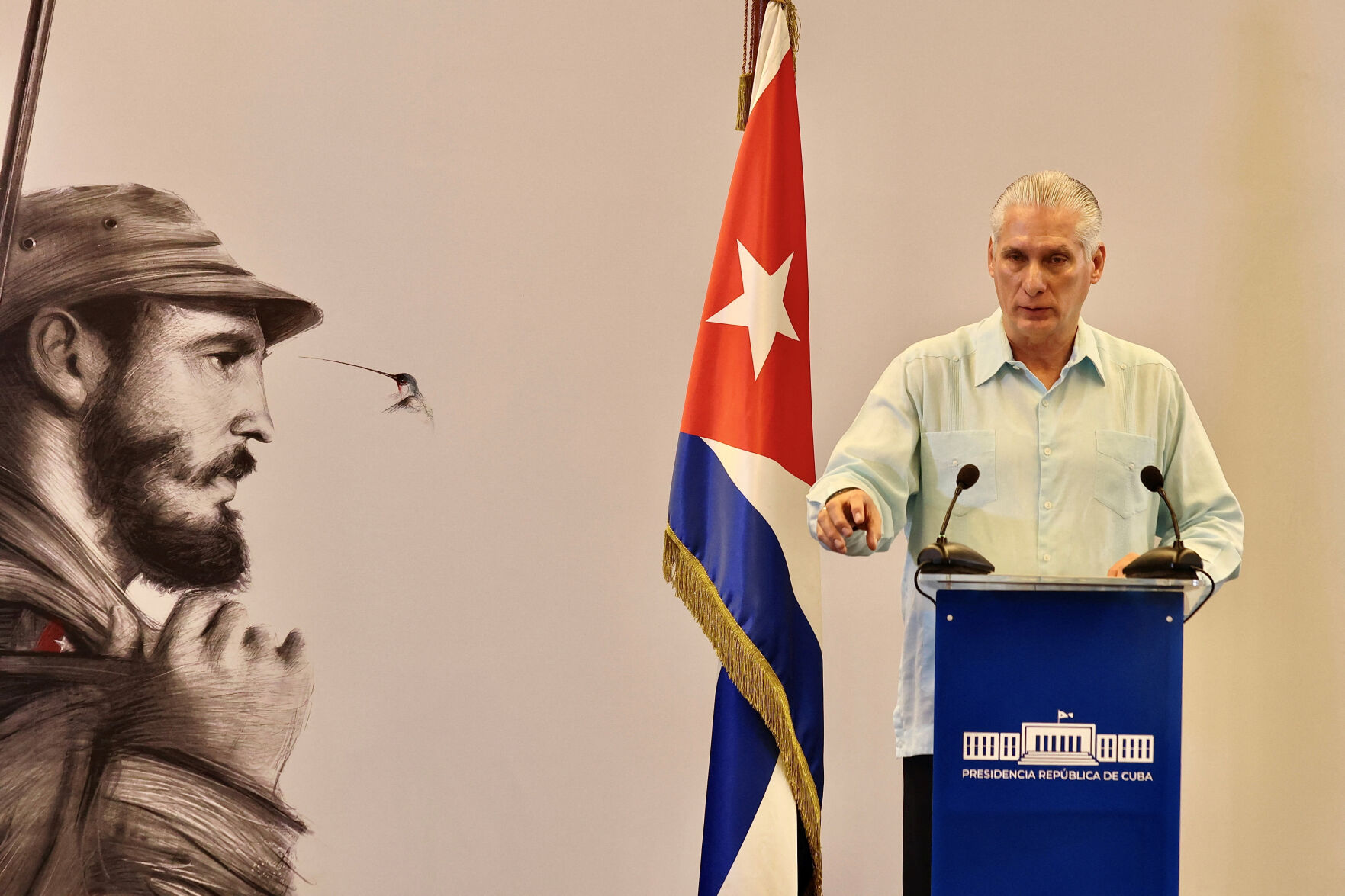
Speculation is mounting about who, if anyone, might replace Cuban President Miguel Díaz-Canel as U.S. President Donald Trump pushes for change in Cuba's leadership. Diaz-Canel was Raúl Castro's handpicked largely figurehead successor in 2018 and the only leader without the last name Castro to govern since the 1959 revolution. He still has two years left in his term —- but some experts and a growing number of Cubans doubt he'll make it. Experts say two Castro cousins have come into focus as potential replacements. They are Oscar Pérez-Oliva Fraga, Cuba's deputy prime minister and Raúl Castro's 55-year-old great nephew, and Raúl Guillermo Rodríguez Castro, Raúl Castro's grandson, who has never held a government position.
President Donald Trump this week said he believes he'll have "the honor of taking Cuba" soon. Without declaring a formal blockade, Trump and his administration have already crippled trade with the island and threatened the future of the Communist Party regime. In March, supplies of oil, food and other goods to the island collapsed, with no foreign-originating tankers arriving to Cuba, according to shipping data analyzed by Windward, a maritime intelligence firm. The volume of port calls, which includes tankers moving from one Cuban port to another, averaged around 50 per month in 2025 but fell to just 11 in March - all of them arriving from domestic ports. It was the lowest since 2017.
President Donald Trump says the United States is talking with Cuba and raised the possibility of a "friendly takeover" of the island without explaining what that means. Trump told reporters on Friday that Secretary of State Marco Rubio is speaking with Cuban leaders at a "very high level," but the White House offered no further details. Trump suggested that Cuba is facing economic collapse. His comments come as Cuba says it is communicating with U.S. officials after a deadly shooting involving a Florida-registered speedboat in waters off the island. Rubio has said that investigators are looking into it.
By SAM MEDNICK, MICHELLE L. PRICE and MATTHEW LEE Associated Press
U.S. President Donald Trump said Friday he's "not happy" with the latest talks over Iran's nuclear program but indicated he would give the negotiators more time to reach a deal to avert another war in the Middle East. He spoke a day after U.S. envoys held another inconclusive round of indirect talks with Iran in Geneva. As American forces gather in the region, Trump has threatened military action if Iran does not agree to a far-reaching deal on its nuclear program, while Iran insists it has the right to enrich uranium for peaceful purposes and denies seeking a nuclear weapon.
Marco Rubio is visiting the Caribbean, where he's defending the Trump administration's military operation to capture Venezuela's Nicolas Maduro. The secretary of state tells leaders from the 15-member Caribbean Community bloc that Venezuela and the region are better off as a result of that U.S. raid. Rubio said Wednesday that he offered the defense without "apology" or "apprehension." Caribbean leaders have been unsettled by the Maduro operation, particularly because it was accompanied by a significant hardening of U.S. policies in the Western Hemisphere.