President Emmanuel Macron is updating France's nuclear deterrence doctrine as Europe worries about Russia and doubts U.S. protection under Donald Trump. On Monday, Macron will speak at a French submarine base and signal how France thinks about using nuclear weapons. The war in Ukraine and Russia's nuclear threats have shaken Europe's security assumptions. Analysts say some Europeans are looking to France for a backup nuclear guarantee. France is the only nuclear power in the European Union. Macron last laid down policy in 2020 and said France has fewer than 300 warheads. Experts are listening for any stronger promise to protect allies.
By SAMUEL PETREQUIN and JOHN LEICESTER Associated Press
France's new prime minister has resigned just a day after naming his government and following less than a month in office. Sébastien Lecornu was France's fourth prime minister in barely a year. The French presidency said Monday that President Emmanuel Macron accepted his resignation. Lecornu's choice of ministers had faced criticism across the political spectrum. His decision to bring back former Finance Minister Bruno Le Maire to serve at the defense ministry was particularly contentious. It's now up to Macron either to name a new head of government or to dissolve the National Assembly and call an early legislative election.
A heat wave has gripped parts of Europe, with temperatures reaching 43 degrees Celsius in southern France. This extreme heat has increased the risk of wildfires, particularly in regions like Hungary and Bulgaria. Fires also caused fresh evacuations in Turkey's northwest. On Monday, France placed 12 departments on red alert, its highest heat warning. Social media images showed empty streets and residents trying to stay cool. The heat wave, France's second this summer, started Friday and is expected to last all week. Other European countries, including Hungary and the U.K., are also experiencing record-breaking temperatures and issuing warnings.
French President Emmanuel Macron praised his country's ties with Britain on the first day of a state visit. The trip that began on Tuesday mixes royal pageantry with thorny political talks about stopping migrants from crossing the English Channel in small boats. Macron and U.K. Prime Minister Keir Starmer will also try to advance plans for a post-ceasefire security force for Ukraine. Macron addressed Britain's Parliament and said that even though Britain has left the EU, it "cannot stay on the sidelines." Macron's three-day stay is at the invitation of King Charles III. It is a symbol of the U.K. government's desire to reset relations with the bloc after Brexit.
Veterans have gathered on the beaches of Normandy to mark the 81st anniversary of the D-Day landings — a pivotal moment during World War II that eventually led to the collapse of Adolf Hitler's regime. Tens of thousands of people attended the commemorations, which included parachute jumps, flyovers, remembrance ceremonies, parades, and historical reenactments. The June 6, 1944, D-Day invasion of Nazi-occupied France was unprecedented in scale and audacity, using the largest-ever armada of ships, troops, planes and vehicles to punch a hole in Hitler's defenses in western Europe. A total of 4,414 Allied troops were killed on D-Day itself.
By SAMUEL PETREQUIN and JOHN LEICESTER Associated Press
The disposal of what Paris police called an "excessively dangerous" unexploded World War II bomb caused hours of transportation chaos on rail and road networks in the French capital. Disposal experts managed to unscrew and then destroy the fuse of the half-ton British-made bomb. But their lengthy operation to make it safe forced the suspension of high-speed train links with London and Brussels. And it forced the cancellation of hundreds of train services and also shut down major roads. Commuters' workdays and passengers' travel plans were upended. The French transport minister expressed relief when it was all over on Friday.
By THOMAS ADAMSON and JEFFREY SCHAEFFER Associated Press
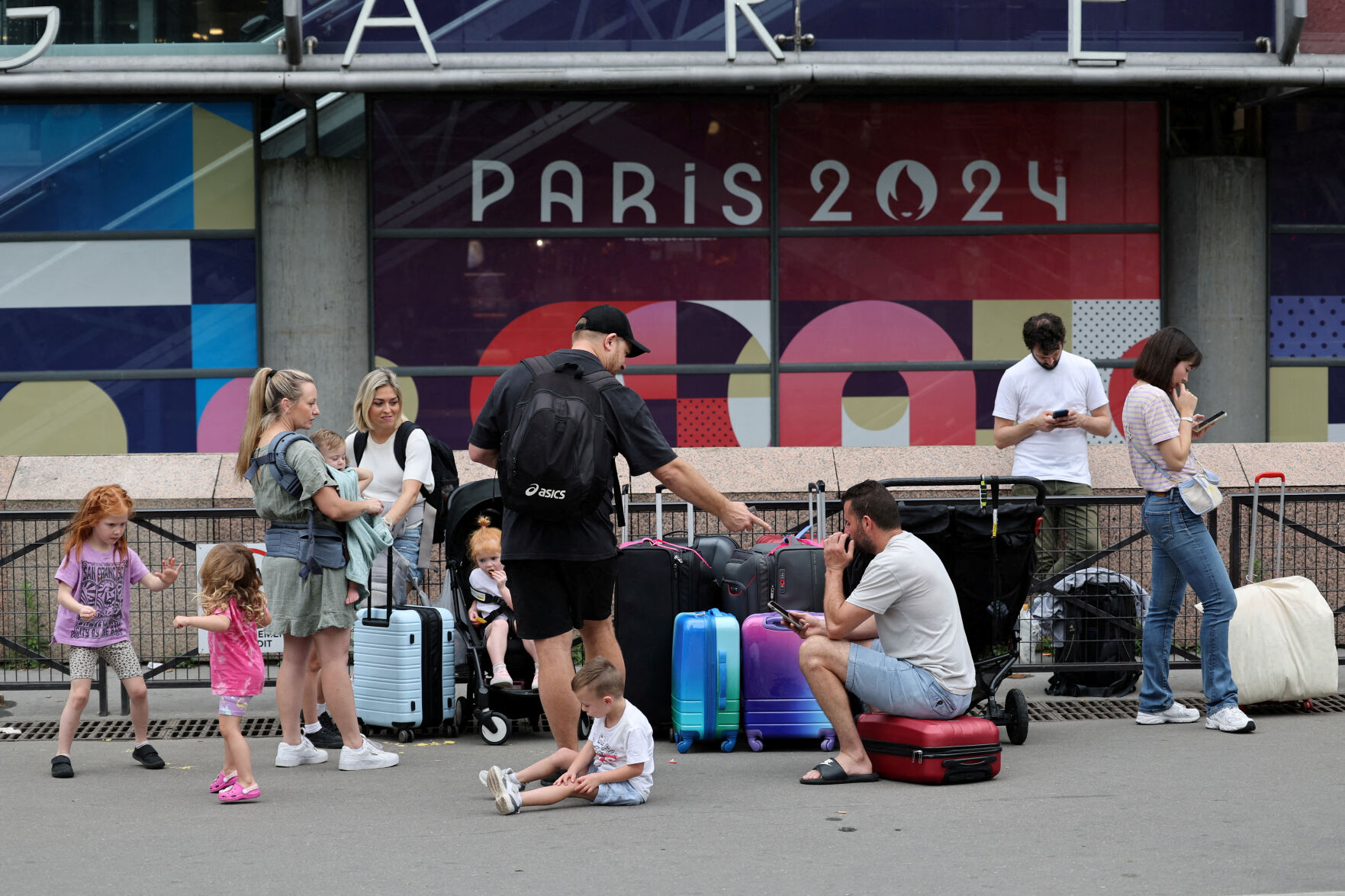
Arsonists have attacked France's high-speed rail network, paralyzing train travel to Paris for some 800,000 people across Europe, including athletes heading to the opening ceremony of the Olympic Games. The saboteurs targeted remote locations far from the capital with apparently coordinated attacks that sought to cut off rail routes into the city from all directions. The fires were predominantly set in pipes containing critical signaling cables for the system known as the TGV. Blazes were reported before dawn near the tracks on three separate lines, causing widespread disruptions. Another arson attempt, in the south in Vergigny, was thwarted by rail agents who scared off several suspects.
By CHRIS MEGERIAN, SYLVIE CORBET and ZEKE MILLER Associated Press
President Joe Biden has for the first time publicly apologized to Ukrainian President Volodymyr Zelenskyy for a monthslong congressional holdup in American military assistance that let Russia make battlefield gains. Biden and Zelenskyy met Friday in France, where they attended ceremonies marking the 80th anniversary of the D-Day landings. Biden told Zelenskyy he apologized to the Ukrainian people for the weeks of not knowing if more assistance would come while Congress waited six months before sending him a $61 billion military aid package. The Democrat insists Americans stand by Ukraine. Biden says: "We're still in. Completely. Thoroughly." Zelenskyy has appealed for bipartisan U.S. support "like it was during World War II."