Armenia is hosting the first European Union summit in Yerevan. The summit on Tuesday marks a deepening of ties that's been years in the making. The summit underscores Armenia's disillusionment with Russia after Moscow failed to intervene during Azerbaijan's 2023 offensive that ended decades of ethnic Armenian control over the Karabakh region. The Armenian parliament passed a law last year formally declaring the country's intention to seek EU membership. But membership prospects remain distant. Armenian authorities accused Russian peacekeepers who were deployed to the region of failing to stop Azerbaijan's onslaught. Armenian Prime Minister Nikol Pashinyan's government has moved to pursue closer ties with the West since then.
Ukrainian President Volodymyr Zelenskyy says his country's top priority is securing help to buy and build more air defense systems. Russia continues its attacks on civilians and infrastructure, and warns that European sites that make drones and other equipment for Ukraine were "potential targets." Zelenskyy is visiting European capitals to secure military and financial support. He aims to boost air defense capabilities, including the Patriot system. Britain plans to send 120,000 drones to Ukraine this year. Meanwhile, Ukraine continues long-range drone attacks on Russia. Defense leaders from over 50 nations are meeting online to coordinate aid for Kyiv.
U.S. Vice President JD Vance says he is in Hungary to support Prime Minister Viktor Orbán's reelection bid. Vance's visit to Budapest on Tuesday marks a clear endorsement from President Donald Trump's administration for Orbán, who is trailing in the polls ahead of Sunday's election. Orbán, a close Trump ally, is running for his fifth term against a strong center-right challenger. Despite Vance's support, he criticized the EU for interfering in Hungary's election. Orbán has been a controversial figure, known for his nationalist policies and opposition to immigration.
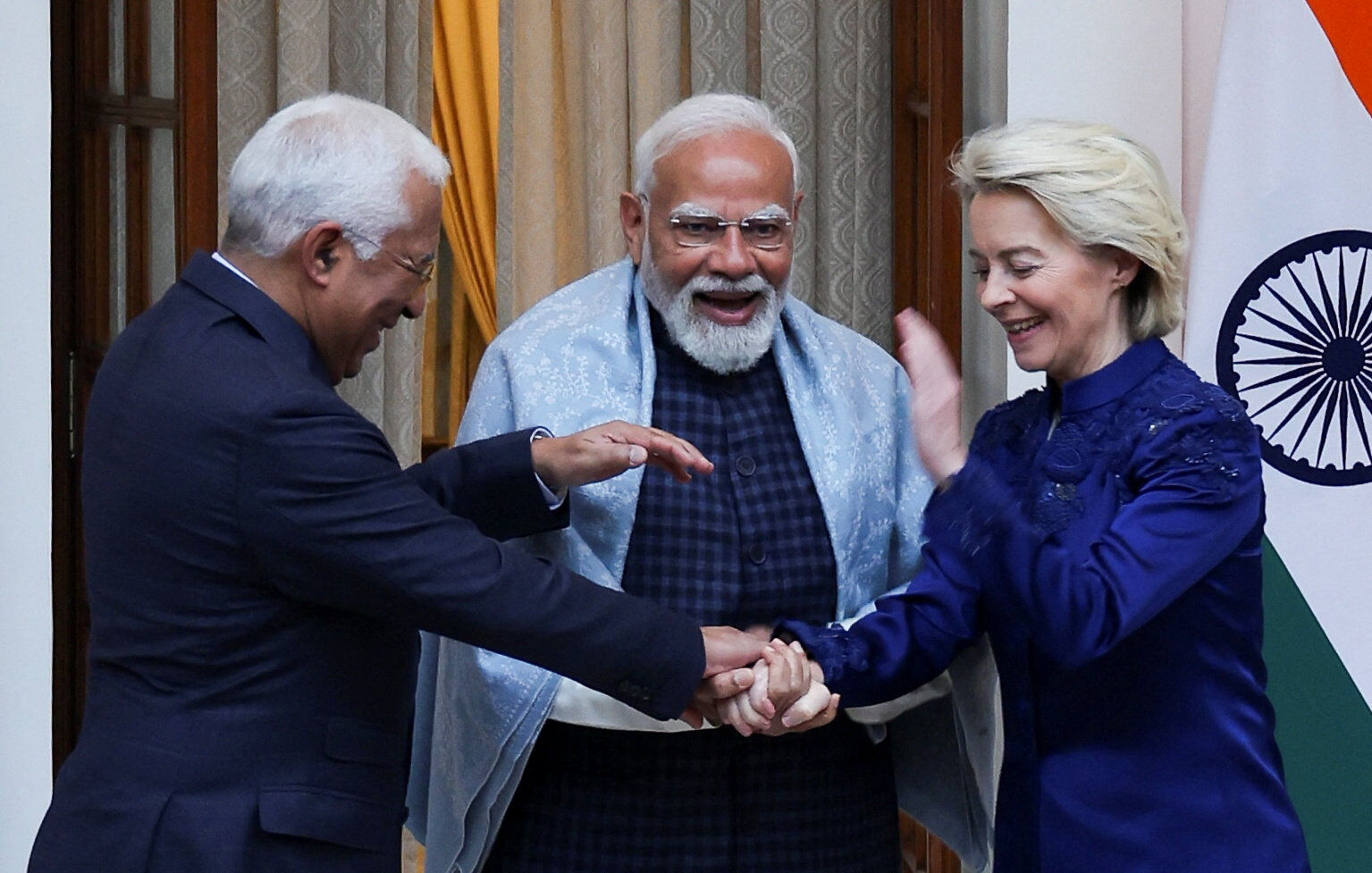
India and the European Union have reached a free trade agreement to deepen economic and strategic ties. The deal covers up to 2 billion people and was reached on Tuesday after nearly two decades of negotiations. It will likely take several months before the agreement takes effect. The deal represents 25% of global gross domestic product and a third of global trade. The agreement aims to lower tariffs, ease regulatory barriers and expand cooperation across goods and services. India will reduce tariffs on 96.6% of EU exports while the EU will reciprocate for nearly 99% of Indian shipments. The deal also includes a framework for deeper defense and security cooperation.
By GEIR MOULSON, EMMA BURROWS and JAMES BROOKS Associated Press
Leader of Denmark and its semiautonomous territory Greenland are insisting that the island's sovereignty is nonnegotiable after U.S. President Donald Trump said he agreed to a framework on Arctic security with the head of NATO. Much about the potential deal remains unclear, though Trump said that "we're going to have total access to Greenland" and "we're going to have all the military access we want." Greenlandic Prime Minister Jens-Frederik Nielsen voiced guarded relief that Trump abruptly dropped his tariff threats and insistence on acquiring the island, but said he knew no concrete details of the agreement Trump cited.
By JAMEY KEATEN, EMMA BURROWS and WILL WEISSERT Associated Press
President Donald Trump's tariff threats over Greenland have strained relations with America's key NATO allies. European leaders, including French President Emmanuel Macron, criticized Trump's approach on Tuesday, warning of potential retaliation. The European Union's top official calls the tariffs a "mistake," questioning Trump's reliability. Trump argues the U.S. needs Greenland to counter threats from China and Russia. Greenland's leader insists on respect for international law. European leaders consider countermeasures, including tariffs and economic sanctions. As tensions rise, Trump plans to address the issue at the World Economic Forum in Davos.
A top European Union official has warned the United States against interfering in European affairs. European Council President António Costa was reacting Monday to the Trump administration's new national security strategy. The document criticizes European allies and offers tacit support to far-right parties in Europe. Costa emphasized that only European citizens can choose their political leaders. The strategy released Friday questions Europe's free speech and migration policies. It underlines the importance of ending Russia's war in Ukraine and improving U.S.-Russia relations. But Costa says it focuses chiefly on the end of hostilities rather than peace and on the stability of relations with Russia.
EU trade ministers have agreed that U.S. President Donald Trump's 30% tariffs announced on the European Union are "absolutely unacceptable," and they are studying a new set of countermeasures to respond to the move. The ministers met Monday in Brussels following Trump's surprise announcement of such hefty tariffs, which could have repercussions for governments, companies and consumers on both sides of the Atlantic. The EU is America's biggest business partner and the world's largest trading bloc. Maroš Šefčovič, the EU's trade representative in its talks with the U.S., said after the meeting that it was "very obvious from the discussions today, the 30% is absolutely unacceptable."
French President Emmanuel Macron praised his country's ties with Britain on the first day of a state visit. The trip that began on Tuesday mixes royal pageantry with thorny political talks about stopping migrants from crossing the English Channel in small boats. Macron and U.K. Prime Minister Keir Starmer will also try to advance plans for a post-ceasefire security force for Ukraine. Macron addressed Britain's Parliament and said that even though Britain has left the EU, it "cannot stay on the sidelines." Macron's three-day stay is at the invitation of King Charles III. It is a symbol of the U.K. government's desire to reset relations with the bloc after Brexit.
Ukraine is moving forward with plans for joint weapons production with allies, while the U.S. halts some arms shipments it had promised to help Kyiv fight off Russia's invasion. Ukraine on Wednesday warned of potential consequences of the U.S. decision. President Volodymyr Zelenskyy says Ukraine will seek joint weapons production with European and other countries. Ukrainian officials said draft legislation to support the effort will be voted on later this month. The U.S. has cited concerns over its own stockpiles for the halt in shipments. The decision has increased pressure on European nations to support Ukraine militarily.