
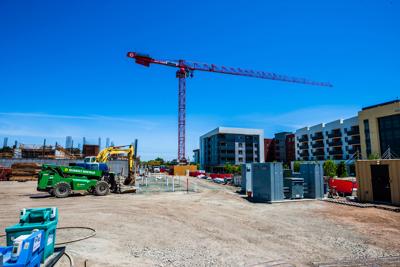
The housing crisis was under assault.
Lawmakers passed legislation catalyzing development, local officials loosened regulations, banks backed by a humming economy offered financing, builders proposing ambitious projects received approvals and cranes littered rising city skylines.
Then everything came to a screeching halt.
Now, new building safety protocol, an upended economy and challenges with planning for an uncertain future are fueling fears the global pandemic will make development more difficult.
“I am concerned about what this is going to mean about any home construction in California in general, because I think this is going to compound the previous problems we had,” said Selma Hepp, chief economist with housing research firm CoreLogic, capturing a widely-shared sentiment that the shutdown would stall the momentum which was building toward addressing California’s housing shortfall.
With limited exceptions for affordable housing developments or projects fixing public safety hazards, Bay Area health officials in April stopped construction to stem COVID-19 transmission.
Prior to the stay-at-home order, projections were that the state needed to build about 3.5 million new homes to accommodate demand and push down the rising cost of living.
Last week, building was allowed to resume. Developers welcomed that with enthusiasm measured by anxieties of operating under the new normal.
Drew Hudacek, chief investment officer with Sares Regis, said the firm specializing in multifamily residential developments was pleased to see the building ban lifted — while keeping a wary eye to health and economic factors.
“It’s a positive step, so long as we do it right and safely and monitor things going forward,” he said. “And we make sure that both the health and financial sides are considered.”
Increased safety, limited production
Worker safety is a paramount concern, said Hudacek, who noted the challenges around introducing social distancing protocol to large construction sites.
He noted the issues range in complexity, from effective bans on carpools for workers accustomed to commuting long distances together to limiting the amount of workers allowed in an area at a time.
There are many necessary health benefits offered by the measures, but there are also costs to losing certain economies of scale, said Hudacek.
“There will be many, many, many inefficiencies that will come into play with social distance and safety protocols. That will be the new normal and we will have to figure that out,” said Hudacek, who added some contractors fear productivity may fall by as much as 60% due to the new requirements.
SummerHill Housing Group CEO Robert Freed too balanced the competing interests of safety and productivity.
“Some of the inefficiencies that are necessary to provide on-job safety and security will slow down the process,” said Freed, whose company also specializes in multifamily development throughout the region.
For his part, Freed said SummerHill implemented a variety of new regulations on job sites such as mandatory temperature checks when entering a construction zone, restricted access points and rotating crews to prevent overpopulation as well as designating a roving inspector to assure workers are wearing appropriate protective gear and keeping a safe distance.
“It’s just going through all the things that cause people to aggregate in small areas and minimizing those,” he said.
Shaky financial landscape
Freed also speculated that the slowed economy may yield difficulties for some developers seeking funding for new developments.
Recommended for you
“Projects that haven’t come out of the ground yet might have trouble with financing,” he said.
Other industry experts agreed, with expectations that banks may be reticent to lend money for developments amid an unstable economy. These anxieties are heightened by local officials establishing rent moratoriums and other restrictions on the flow of money into the real estate sector, setting off a chain reaction of debt and risk sensitivities.
“I would not be surprised if the financial basis for these projects might be teetering a little bit,” said Burlingame Community Development Director Kevin Gardiner.
Tax income loss suffered by cities further compound the monetary challenges, said Hudacek, who noted discussions of budget limitations growing more common among Peninsula officials.
“Every city we have talked to is concerned about their budget,” he said.
Planning for an uncertain future
Despite the financial restraints, Hudacek credited the effectiveness of local planners working amid the shutdown to process proposals and advance projects already in the development pipeline.
With reliance on digital or online services, officials in San Mateo, South San Francisco and Burlingame said they were able to avoid a logjam of projects which could have formed during quarantine.
“We have kept projects moving, including permit issuance and inspections when needed,” San Mateo City Manager Drew Corbett said in an email. “We are also improving our remote and digital/online services as we speak so we feel like we are well positioned once things return to a more normal state.”
Alex Greenwood, Economic and Community Development director in South San Francisco, agreed. He said the city’s advanced application system was positioned to process a variety of commercial and residential developments, which otherwise could have laid idle.
For his part, Gardiner noted Burlingame’s pivot to operating public meetings remotely and pointed to a recent Planning Commission meeting in which officials were able to review a 300-unit housing development from their homes.
Hepp said such an ability is relatively unique to the Bay Area and other metropolitan centers. Across the rest of California, many builders expressed concerns that all projects would come to a standstill during the shutdown and that backlog of planning would cause a ripple effect for future development.
She also noted greater planning challenges on the horizon, with questions over how COVID-19 may alter perspectives on development trends.
“What does this mean for cities going forward in terms of where people want to live? Does this mean we will see more spreading out into less dense communities?,” she asked.
Hepp also acknowledged the chance that some development foes could use fears of virus transmission to bolster arguments against projects they oppose.
“Sometimes people use these events to advance their interests,” she said.
While myriad questions circle the future of housing, Freed balanced the prevailing uncertainty against a confidence bolstered by experience of seeing the industry evolve over many years.
Citing the region’s resiliency through previous economic downturns, as well as a hearty economic foundation and need to continue building, Freed shared some hopefulness for the future.
“I have to be optimistic for all those reasons,” he said. “I also believe it is going to be a tough slugfest for a couple years”
(650) 344-5200 ext. 105







(0) comments
Welcome to the discussion.
Log In
Keep the discussion civilized. Absolutely NO personal attacks or insults directed toward writers, nor others who make comments.
Keep it clean. Please avoid obscene, vulgar, lewd, racist or sexually-oriented language.
Don't threaten. Threats of harming another person will not be tolerated.
Be truthful. Don't knowingly lie about anyone or anything.
Be proactive. Use the 'Report' link on each comment to let us know of abusive posts.
PLEASE TURN OFF YOUR CAPS LOCK.
Anyone violating these rules will be issued a warning. After the warning, comment privileges can be revoked.