
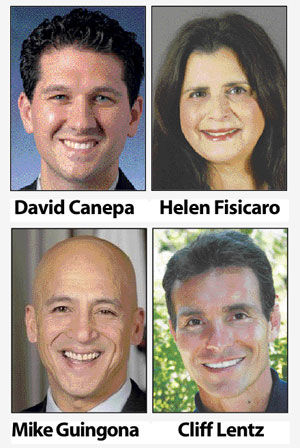
With about a month left before the June 7 primary, the four candidates aiming to replace Adrienne Tissier on the San Mateo County Board of Supervisors are in full campaign mode.
Some have raised more money and others have secured significant endorsements as voters in District 5 in the north county will for the first time elect their representative directly.
The seat was filled previously by a countywide vote.
The four candidates are Daly City Vice Mayor David Canepa, Colma Vice Mayor Helen Fisicaro, Daly City Councilman Mike Guingona and Brisbane Mayor Cliff Lentz.
The Daily Journal sat all four candidates down for endorsement interviews to get their perspective on the area’s vital issues and why they would be best to represent the district for a seat Tissier has held for 12 years. She is being termed off the board. She is also endorsing Fisicaro for the job as are supervisors Carole Groom and Warren Slocum.
Lentz has secured the endorsement of Supervisor Dave Pine while Supervisor Don Horsley has yet to endorse a candidate.
Most of the 58,716 voters in the district, about 66 percent, reside in Daly City with the rest living in Brisbane, Colma, Broadmoor, parts of South San Francisco and parts of San Bruno.
The big issues to solve regionally are the same for the candidates as the region is in the midst of a housing crisis and traffic on area highways becomes increasingly clogged — but each has their own ideas on how to solve them.
Improved access to health care and education are also issues on which the candidates are campaigning.
When it comes to tackling the housing crisis, Canepa supports a $300 million bond measure to leverage with nonprofit partners to build more housing, particularly along the El Camino Real corridor close to transit centers.
Guingona, however, thinks “throwing money at the problem” won’t solve the crisis although he would like to see more Measure A sales tax revenue be earmarked for affordable housing.
Daly City has done its part in building affordable housing but it’s a local control issue, said Guingona, a criminal defense attorney.
“I am an advocate for density,” said Guingona, who also added that a good economy can lead to bad traffic. He thinks cities could ease restrictions on density to build more affordable housing.
There is no “short-term” answer to solving the crisis although building more housing is the “solution,” he said.
Fisicaro said the private sector needs to be engaged to help solve the housing crisis.
The nonprofit Housing Leadership Council estimates the county needs to build 24,000 affordable homes for very low- and extremely low-income families to meet the needs of the current workforce.
In the last three years, San Mateo County has added 40,000 new jobs but built only 3,000 new homes.
“The only solution you hear is rent control but it won’t work here,” Fisicaro said.
The problem is getting private owners to release their land for affordable housing, she said.
“How do you convince them to build that housing?” she said.
An effort to solve the housing crisis must go beyond the Closing the Jobs/Housing Gap Task Force that has been meeting for the past several months, she said.
The task force is expected to release a report soon on its findings.
The average rent in the county for a one-bedroom is now $2,575 a month, a 52.3 percent increase in four years.
Lentz envisions himself as a conduit between the cities and county when it comes to affordable housing.
“We have to look at housing elements and help cities achieve their goals,” Lentz said.
He thinks school districts, which are rich in land and poor in cash, should be engaged also to help build more workforce housing.
The county should also help nonprofit agencies like HIP Housing to expand services such as shared housing.
He does not favor rent control but said some large landlords have voluntarily capped yearly rent increases and that others should follow.
For Lentz, education is the biggest issue in the county, especially early education.
“We need to get kids reading at grade level,” Lentz said.
He also wants to “capture teens who don’t go to college” so that they have access to trade schools or vocational programs at the community college level. Universal preschool should also be a priority, he said.
Fisicaro also supports trade schools and vocational training.
“Not everyone can go to a four-year college,” she said.
The gap, she said, is wider in the north county when it comes to children and reading skills.
Guingona, from Daly City, went to Skyline College before transferring to a four-year university.
“I’m a big advocate for transferring,” he said.
County officials, however, do not have any control over local school districts or the San Mateo County Office of Education.
Recommended for you
Access to health care in the north county is a bigger issue for Canepa.
With the recent sale of Seton Medical Center, there is concern services at that hospital might erode in the coming years, he said.
But getting to the county-owned medical center in San Mateo can be burdensome for residents in the north county, he said.
The county does operate the Mike Nevin Health Center in north county but appointments are hard to get, Canepa said.
“The demand is so high that we have to increase capacity,” Canepa said. Seniors have an especially hard time traveling to San Mateo to access health care services, he said.
He would like to continue Tissier’s “Seniors on the Move” yearly event.
The district is aging, he said, and seniors need to be connected to the resources they need, much of which are centered in Redwood City or San Mateo.
Fisicaro also wants to continue the “Seniors on the Move” events and continue Tissier’s role in the annual San Mateo County Disaster Preparedness Day.
Fisicaro hopes to provide the same female presence on the board Tissier has provided and wants to ease into office slowly when it comes to policy.
“I want to learn the job and get up to speed. I’m not going to go to fast with policy,” said Fisicaro, who has served the Colma City Council for two decades.
Guingona touts his experience on the Daly City Council as a reason to vote for him.
“You can’t get anything done on your own. You’ve got to have a big tent, not ideas,” Guingona said.
He’s been critical of Canepa’s idea to have a dedicated district office in the north county to serve constituents.
Tissier had one but it was rarely used, he said. She just closed it, he said.
Lentz hopes he can join the board to support Supervisor Pine and his initiatives.
“We can create a synergy to bring more services to the north county,” he said.
Land-use policy, Lentz said, can create healthy communities.
He also thinks he’s the right candidate to get the private sector more involved in improving educational opportunities in the district.
As a supervisor, Lentz hopes executives such as Facebook founder Mark Zuckerberg will give him an audience to discuss his company’s role in solving regional issues such as traffic.
Income inequality is a big issue in the district, Lentz said.
“This is a middle class district. The high cost of housing is squeezing out our teachers, librarians and retail workers,” he said.
Canepa said Tissier’s role on the board has been great for the region especially when it comes to transportation and public safety.
He intends, however, to be a proactive legislator. With property crimes on the rise, the county may have to adjust its policies related to incarceration and programs to reduce recidivism. The new jail in Redwood City should not just be a jail but a place to help low-level criminals transition back into the community, he said.
“How do we keep people out of jail? Incarceration is not the answer,” Canepa said. “There must be alternatives.”
He also wants to create a “livable wage” in the county.
“$15 is not enough,” Canepa said about the state’s move to lift the minimum wage to $15 by 2022.
None of the candidates support rent control but they all support adding carpool lanes in the county.
Three do not support toll lanes but Lentz said, “I’m not sure.”
When it comes to garnering campaign contributions, Canepa is the leader.
He’s raised nearly $184,000 and still has about $88,000 to spend on his campaign.
Guingona has raised about $88,000 and has $61,000 left to spend on the campaign.
Fisicaro has loaned her campaign $85,000 and has raised another $60,000 in donations. She has a little less than $50,000 in cash to spend on her campaign, according to campaign finance forms filed with the county.
Lentz too has loaned his campaign about $22,000 and raised another $38,000 from donors. He has about $45,000 left to spend on his campaign.
If none of the candidates earn 50 percent of the vote June 7, the top two vote getters will square off in November.
(650) 344-5200 ext. 102







(0) comments
Welcome to the discussion.
Log In
Keep the discussion civilized. Absolutely NO personal attacks or insults directed toward writers, nor others who make comments.
Keep it clean. Please avoid obscene, vulgar, lewd, racist or sexually-oriented language.
Don't threaten. Threats of harming another person will not be tolerated.
Be truthful. Don't knowingly lie about anyone or anything.
Be proactive. Use the 'Report' link on each comment to let us know of abusive posts.
PLEASE TURN OFF YOUR CAPS LOCK.
Anyone violating these rules will be issued a warning. After the warning, comment privileges can be revoked.