
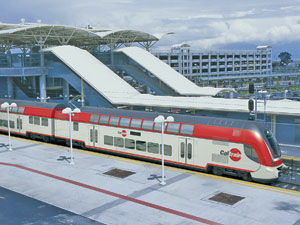
After months of advocating to modernize the Peninsula’s commuter rail line, it’s full-speed ahead for Caltrain electrification as federal officials announced the regional transit agency’s $647 million grant would finally be approved.
From congressional representatives to Gov. Jerry Brown and Silicon Valley business leaders to transportation advocates, a flurry of excitement followed the Federal Transit Administration’s announcement Monday.
The news was a surprise to many as the nation’s top transportation official said funding wasn’t yet available and the FTA previously indicated it would await the president’s 2018 budget proposal.
Now, a nearly 150-year-old diesel rail line will be modernized to reduce greenhouse gas emissions, increase commuter capacity in one of the world’s most economically productive corridors, and potentially help alleviate some of the Bay Area’s traffic woes.
Caltrain CEO Jim Hartnett thanked the robust group of supporters, including a Democratic congressional delegation and state leaders, who’d fought for the requisite federal funds that had been put on hold earlier this year.
“Of course, this milestone is only possible because of widespread and vocal support from the communities we serve. Throughout this effort, Caltrain riders, businesses and residents throughout the region have been resolute in their support for a better Caltrain. We are very grateful, and we look forward to rewarding those efforts by getting to work right away building the transit system this region deserves,” Hartnett said in a statement.
The shovel-ready project includes purchasing new trains and electrifying 51 miles of track between San Jose and San Francisco, which is expected to produce nearly 9,600 jobs across more than a dozen states.
Officials now anticipate beginning construction within 90 days and commuters starting to hail electric trains by early 2021, said Jeff Gee, chair of the Caltrain Board of Directors.
“We’re ecstatic about it,” Gee said. “This is not a project just for Caltrain and the Peninsula, it’s going to help the entire region. The jobs, the people, the economy, the traffic relief; it’s going to benefit everyone.”
The brakes had been pulled on Caltrain’s $1.98 billion Modernization Program earlier this year when newly appointed Transportation Secretary Elaine Chao said she would await direction from President Donald Trump’s budget before approving the federal support. Her decision came shortly after Republicans in the Central Valley sent a letter opposing the project citing its relation to the state’s high-speed rail project.
Opponents raised concerns as the state’s $64 billion project is slated to share Caltrain’s Peninsula corridor as part of the “blended system.” But while the controversial high-speed rail slowly chugs along, Caltrain proponents noted electrification would have independent benefits for local commuters regardless of whether the state project comes to fruition.
Caltrain is slated to receive $713 million in high-speed rail funds, along with other state, regional and local funding sources. Those funds had been on hold pending the FTA’s approval and the federal grant that accounts for nearly a third of the project cost.
Even as recently as last week, Chao indicated the funds weren’t available for her to approve Caltrain’s grant, which had already been vetted by FTA staff over the course of nearly two years. But on Monday, the FTA said it intends to approve sign-off on the final step — a full funding grant agreement that will allow Caltrain to receive funds allocated during the federal budgetary process.
Caltrain has $173 million in federal support in the pipeline that was awaiting the grant agreement — that includes $73 million allocated during the Obama administration and $100 million approved by Congress earlier this month in the 2017 federal spending plan.
“Caltrain’s fleet of diesel trains are at the end of their useful life. Now is the time to replace these outdated dirty diesel trains with a cleaner, modern electric fleet,” U.S. Sen. Dianne Feinstein said in a statement. “For the past three months we’ve waited to hear the status of the grant, while Caltrain was forced to spend roughly $15 million to hold its contractors in place. With this agreement, the project can finally begin.”
Recommended for you
Timing was of the essence for Caltrain, which has already-approved agreements with engineering firms to lock in the project’s price. Having spent millions of dollars to extend those agreements to June 30, failing to receive federal support could have completely derailed electrification.
Over the last few months, a pool of supporters — including business leaders, transit advocates, congressional representatives and even Gov. Brown — had been lobbying the White House and federal transportation officials to advance Caltrain’s project.
“This shovel-ready project will help expand service on an already congested corridor, improve air quality and put thousands of people to work. Secretary Chao did the right thing on Caltrain. This is not only good for California, it’s good for America,” Brown said in a statement.
With the FTA’s announcement, Assemblyman Kevin Mullin urged Sacramento to begin releasing state allocations to help the project along. Mullin, D-South San Francisco, authored legislation clarifying that high-speed rail funds could be spent on the Peninsula corridor.
“I am thrilled,” Mullin said in response to the FTA’s announcement. “While the electrification of Caltrain will provide a cleaner, faster, quieter rail system that will take cars off our roads, this project will benefit our growing region environmentally and economically for years to come.”
Modernizing the rail line will nearly double ridership capacity to 110,000 and save an estimated 619,000 vehicle miles every day by removing cars off the increasingly congested Highway 101 and Interstate 280, according to Caltrain. It will also reduce commute times from San Jose to San Francisco by nearly 15 percent.
As weekday Caltrain ridership has continuously climbed over the last few years, the transit agency was desperately seeking to increase capacity. Bay Area business leaders stepped in as strong proponents of modernizing the Peninsula’s rail system noting its key role in bolstering one of the nation’s most productive economies.
The Silicon Valley Leadership Group joined efforts to urge the FTA to approve the transportation project that will have rippling benefits to the region and nation.
“This news, quite clearly, is electrifying,” SVLG Executive Director Carl Guardino said in a statement. “This single step nearly doubles Caltrain ridership, which is a game changer for the congested Highway 101 corridor.”
Monday’s surprise announcement marked a vital step for the region and those who’d been fighting to keep the project on track.
“This critical upgrade is one of the key transportation job creators in the county. It will enhance the spine of the Silicon Valley transportation system. It’s a win for the environment,” U.S. Rep Anna Eshoo, D-Palo Alto, said in a statement. “Passenger service began on this corridor during the presidency of Abraham Lincoln over 150 years ago. Today, I am proud that our generation is able to build something worth of the future of our region. This is an ‘Alleluia’ moment.”
(650) 344-5200 ext. 106
Twitter: @samantha_weigel





(0) comments
Welcome to the discussion.
Log In
Keep the discussion civilized. Absolutely NO personal attacks or insults directed toward writers, nor others who make comments.
Keep it clean. Please avoid obscene, vulgar, lewd, racist or sexually-oriented language.
Don't threaten. Threats of harming another person will not be tolerated.
Be truthful. Don't knowingly lie about anyone or anything.
Be proactive. Use the 'Report' link on each comment to let us know of abusive posts.
PLEASE TURN OFF YOUR CAPS LOCK.
Anyone violating these rules will be issued a warning. After the warning, comment privileges can be revoked.