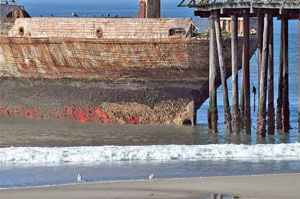
There’s not much left of the SS Palo Alto, a ship made of concrete that has been an attraction near Santa Cruz for decades. The recent storms battered the grounded ship so severely the hull split apart, pretty well closing the log on a story that started in Redwood City during World War I with the launching of a ship named Faith.
Shipbuilders must have had a great deal of faith when they drew up plans for a concrete ship. The Faith was the first American ship constructed of a material skeptics thought would sink like a rock.
The freighter, its black hull made entirely of concrete, was launched in Redwood City on March 18, 1918, to great fanfare. The Redwood City Democrat reported spectators came “from every direction by train, in automobile and by water” to see an event the newspaper predicted would “revolutionize the shipbuilding of the world.” The ship didn’t live up to that billing, but it had a longer life than naysayers expected. Faith hauled general cargo to ports of call as far apart as Honolulu and New York before its sailing days ended in 1921 and it became a breakwater in Cuba.
The ship was launched in the midst of World War I when the United States lacked enough steel-making plants and shipyards. Historians say that at the time Faith was the world’s largest sea-going concrete vessel.
Using concrete for a ship was an idea pushed by Leslie Comyn, a San Francisco business executive who owned a shipyard in Redwood City. He convinced the wartime U.S. Shipping Board to commission five reinforced concrete steamers, assuring the board that the 5,000-ton ships could be operated at a profit. Redwood City had a long history with cement, which was produced using oyster shells and mud on what is now Pacific Shores Center. Cement is a vital component of concrete.
Recommended for you
Faith was one of three concrete ships built in the San Francisco Bay Area during World War I. The others, all part of Comyn’s venture, were the Peralta and the Palo Alto, both of them built as tankers in Oakland. The war ended before the other two ships of the five awarded to Comyn were completed.
The Palo Alto sailed on only one voyage and that was under tow from Oakland to her present port at Seacliff State Beach at Aptos about eight miles south of Santa Cruz where it served most recently as a fishing pier. When it arrived on the coast, the ship’s seacocks were opened and the Palo Alto settled in. In 1930, a pier was built to the vessel and a dance floor, swimming pool and cafe were added, giving the ship a new life. The owners, however, went broke after two seasons.
The Peralta, according to the website Concrete Ships, became a sardine cannery in Alaska in 1924 and was later moored off Antioch, California until 1958 when it became part of a breakwater for a pulp and paper mill in British Columbia, Canada, where it remains.
A ship made of concrete? A crazy idea, right? Apparently not because more than 20 were built during World War II as well as nearly 80 concrete barges, including some that played a vital role in the D-Day invasion of Normandy where they were used as floating pontoons to move troops and supplies.
The Rear View Mirror by history columnist Jim Clifford appears in the Daily Journal every other Monday. Objects in The Mirror are closer than they appear.
Keep the discussion civilized. Absolutely NO
personal attacks or insults directed toward writers, nor others who
make comments. Keep it clean. Please avoid obscene, vulgar, lewd,
racist or sexually-oriented language. Don't threaten. Threats of harming another
person will not be tolerated. Be truthful. Don't knowingly lie about anyone
or anything. Be proactive. Use the 'Report' link on
each comment to let us know of abusive posts. PLEASE TURN OFF YOUR CAPS LOCK. Anyone violating these rules will be issued a
warning. After the warning, comment privileges can be
revoked.
Please purchase a Premium Subscription to continue reading.
To continue, please log in, or sign up for a new account.
We offer one free story view per month. If you register for an account, you will get two additional story views. After those three total views, we ask that you support us with a subscription.
A subscription to our digital content is so much more than just access to our valuable content. It means you’re helping to support a local community institution that has, from its very start, supported the betterment of our society. Thank you very much!






(0) comments
Welcome to the discussion.
Log In
Keep the discussion civilized. Absolutely NO personal attacks or insults directed toward writers, nor others who make comments.
Keep it clean. Please avoid obscene, vulgar, lewd, racist or sexually-oriented language.
Don't threaten. Threats of harming another person will not be tolerated.
Be truthful. Don't knowingly lie about anyone or anything.
Be proactive. Use the 'Report' link on each comment to let us know of abusive posts.
PLEASE TURN OFF YOUR CAPS LOCK.
Anyone violating these rules will be issued a warning. After the warning, comment privileges can be revoked.