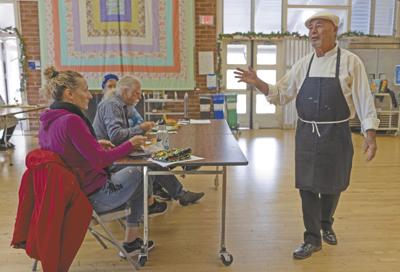
Chef Steve Cortez prepares plates of traditional Mexican tamales, rice and beans for participants of a mini tamalada hosted in partnership with Redwood City on Saturday, Dec. 3.
Arianna Cuhna/Daily Journal
Chef Steve Cortez leads tamalada participants through a taste test and history lesson about tamales.
Making tamales — a traditional dish seen across Latin America and in other parts of the world — can bring communities together, which was the goal of chef Steve Cortez and his wife Laurel Laran who held Redwood City’s first tamalada.
“A tamalada is a community and family event. It’s a special experience in that its intent is to bring family together and community together,” said Cortez, a Bay Area native with about two decades of experience teaching culinary skills to the public.
Two groups of 30 people gathered on Saturday, Dec. 10, at the Highlands Community Club to be led through the history of tamales and a demonstration on how to make the dish at home.
Participants came from all types of backgrounds, Cortez said. Some took the class as a family while others came as couples, co-workers or from church groups. Some had never made a tamale in their life, while others were looking to reintroduce themselves with a family pastime.
Regardless of who came, Cortez said his main objective was to make the tamale-making process, often considered daunting, more approachable.
Tamales have existed for thousands of years and come in all sorts of different flavors and styles inspired by the regions in which they are made including Latin America, the Caribbean, the Philippines and Guam, Cortez noted. As a base, the dish requires wrapping a dough, usually made from corn, and a filling, made of meat, fruit, vegetables or cheese, in a husk or leaf and then steaming them in a pot.
The dish is often prepared around the holidays by groups of family members, a gathering, known as a tamalada, that Laran said is meant to bring people together.
“It’s a moment in time you’re dedicated and focused and engaged — all together in this joyous occasion and just the art of food, making food, communicating, being in a warm environment. That’s a big deal,” Laran said.
Recommended for you
During Saturday’s event, participants learned how to make Mexican tamales — a corn dough known as masa with a savory filling made with pork and red chili sauce and corn husk wrapper. In total, the event took two hours from start to finish but much more time was spent preparing each element of the dish, Cortez said.
Leading up to the event, Cortez said 75 pounds of pork was stewed for up to five hours in red chili sauce before each 5-pound piece was hand shredded, the most time-consuming step, he said. The masa was also pre-made and husks soaked before participants arrived.
When it came time to assemble the tamales, participants were walked through how to spread the masa on a piece of husk before placing the filling inside and rolling up the pocket, creating a tamale.
Rather than cook the tamales on-site, Cortez said participants were taught how to steam them at home using typical appliances found in an average kitchen and were sent home with a packet of information detailing everything included in the lesson.
Before leaving, the groups gathered and enjoyed tamales made fresh that morning. The goal, Cortez and Laran said, was to encourage participants to mingle whether they came together or not and to leave feeling confident they could recreate the magic of the meal.
Redwood City was the perfect location for their tamalada event, Laran said. The city is sandwiched between San Francisco and San Jose, two big cities where similar classes are offered but at a much higher price. Cortez noted some classes start at $120 per person, shutting the average person like teachers, city employees and others who “don’t have the big bucks” out of the lesson.
The dish is also one often made by residents living in and around Redwood City, making it a warm introduction to the cultures of neighbors. Both shared hope that more communities would begin hosting tamaladas, noting the events bring people together.
“People think it’s very complex. It’s not complex,” Cortez said. “Get your flame or light going, get prepared, set aside some time and turn off the cellphone and enjoy making tamales.”
Keep the discussion civilized. Absolutely NO
personal attacks or insults directed toward writers, nor others who
make comments. Keep it clean. Please avoid obscene, vulgar, lewd,
racist or sexually-oriented language. Don't threaten. Threats of harming another
person will not be tolerated. Be truthful. Don't knowingly lie about anyone
or anything. Be proactive. Use the 'Report' link on
each comment to let us know of abusive posts. PLEASE TURN OFF YOUR CAPS LOCK. Anyone violating these rules will be issued a
warning. After the warning, comment privileges can be
revoked.
Please purchase a Premium Subscription to continue reading.
To continue, please log in, or sign up for a new account.
We offer one free story view per month. If you register for an account, you will get two additional story views. After those three total views, we ask that you support us with a subscription.
A subscription to our digital content is so much more than just access to our valuable content. It means you’re helping to support a local community institution that has, from its very start, supported the betterment of our society. Thank you very much!











(0) comments
Welcome to the discussion.
Log In
Keep the discussion civilized. Absolutely NO personal attacks or insults directed toward writers, nor others who make comments.
Keep it clean. Please avoid obscene, vulgar, lewd, racist or sexually-oriented language.
Don't threaten. Threats of harming another person will not be tolerated.
Be truthful. Don't knowingly lie about anyone or anything.
Be proactive. Use the 'Report' link on each comment to let us know of abusive posts.
PLEASE TURN OFF YOUR CAPS LOCK.
Anyone violating these rules will be issued a warning. After the warning, comment privileges can be revoked.